Showing posts with label San Telmo. Show all posts

Its time for asado - Buenos Aires style


It is time for an asado.

Asado is taken very seriously here in Buenos Aires.”How is your asado?” is the third question that a woman will ask a prospective fiancé after “are you solvent”, and “are you generous or mean”. Unless she is a tanguera, when the only question is “can you dance tango?”.

Fortunately for me, Stephanie is more interested in the butcher than my asado skills. Jose, Pascual y Gascon have run unit 54 in San Telmo market for 40 years without a break. Part of the fabric of the market, they are always thrilled to see Stephanie and hear her request. “Un bife de lomo”, says Stephanie to Pascual, at which he will scowl with mock disbelief, dart furtively into the chill store and return with a smile and 600-800 gms of pure beef filet.


One of our first purchases on arrival in Buenos Aires was a small parrilla (pronounced ‘par-y-sha’). For this we went to Casa Bella, Independencia 1502, a hardware shop in Monserrat stuffed with every kind of device from the ‘patio portable’ to huge 2m long grills opening into brick chimneys. We opted for a small, slim grill that would sit on the roof and be easily protected from rain. Armed with a 4kg  bag of organic charcoal from the grocers in Defensa and a fistful of twigs retrieved from beneath the plane trees of Paseo Colon, we were set to asado. 


In less kind climes, lighting the parrilla can be a tortuous task. Here in Buenos Aires, with long summer days, it is relatively simple, for the metal and tiles of the grill are already hot from the sun. The ‘art’, apparently, is to nest the charcoal - spaced so that it can breathe, but sufficiently close that it will catch and spread. When the bloom of ash is evident on one side of a coal, simply turn it to allow contact with the other side. Once lit, the next imperative is to open your first bottle of Malbec and pour a glass or two. Rushing an asado can be fatal: you need at least 30-45 minutes of steady, quiet, smokeless, ash-covered coals before dreaming of adding meat.
 

Barbecue in Britain tends to be an unseemly active affair. You will see men (for it seems to be a ‘male thing’ to light fires to cook meat) in a sweat, rushing pieces of chicken from scorch to safety, or flapping at flames as dripping fat catches. 

Here in Buenos Aires, movements are molecular. The asador will stir as if from deep contemplation, to squint at the asado. He will breathe deeply to summon energy, perhaps sing a phrase or two of Fresedo, then rise purposely. Unless absolutely necessary, the meat will stay exactly where it was placed, simply to be turned when needed. Cooking asado is slow; leisurely. The charcoal may be hot, yet the rack for meat is spaced well away. My Porteno asadors tell me that beef matures with slow cooking, producing a crisp outer skin and soft, succulent, moist interior.

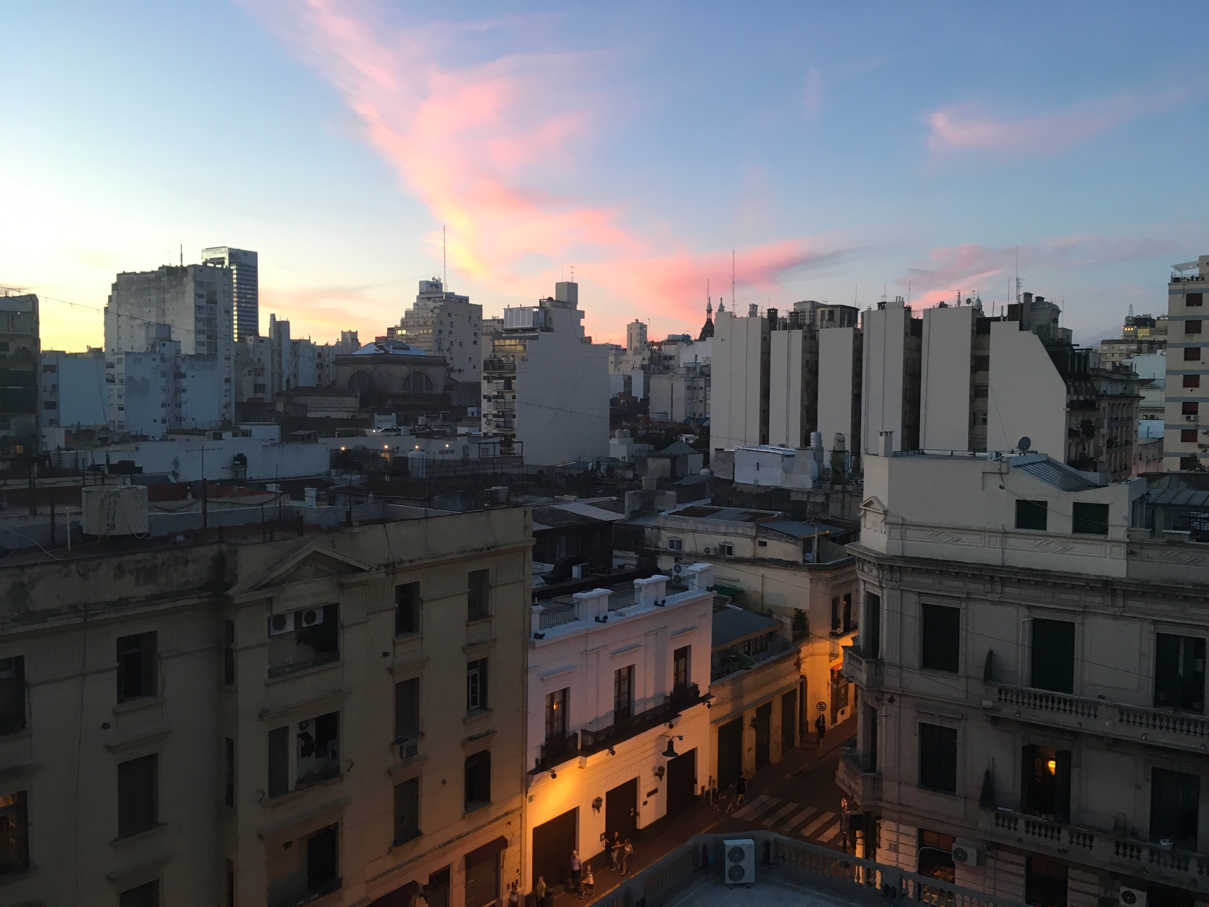
Asado for Stephanie and me has an added joy of a rooftop view across the barrio to Puerto Madero and San Nicolas. The scene before us extends for two kilometers over 200 degrees. Above, the sky is a sparkling azure blue peppered only by the swifts in aerial displays, racing teams of green parakeets and the odd dove settling into a tree. Below, countless roofs of inumerable homes; and occasionally from one of them the tell-tale spiral of smoke from another asado.


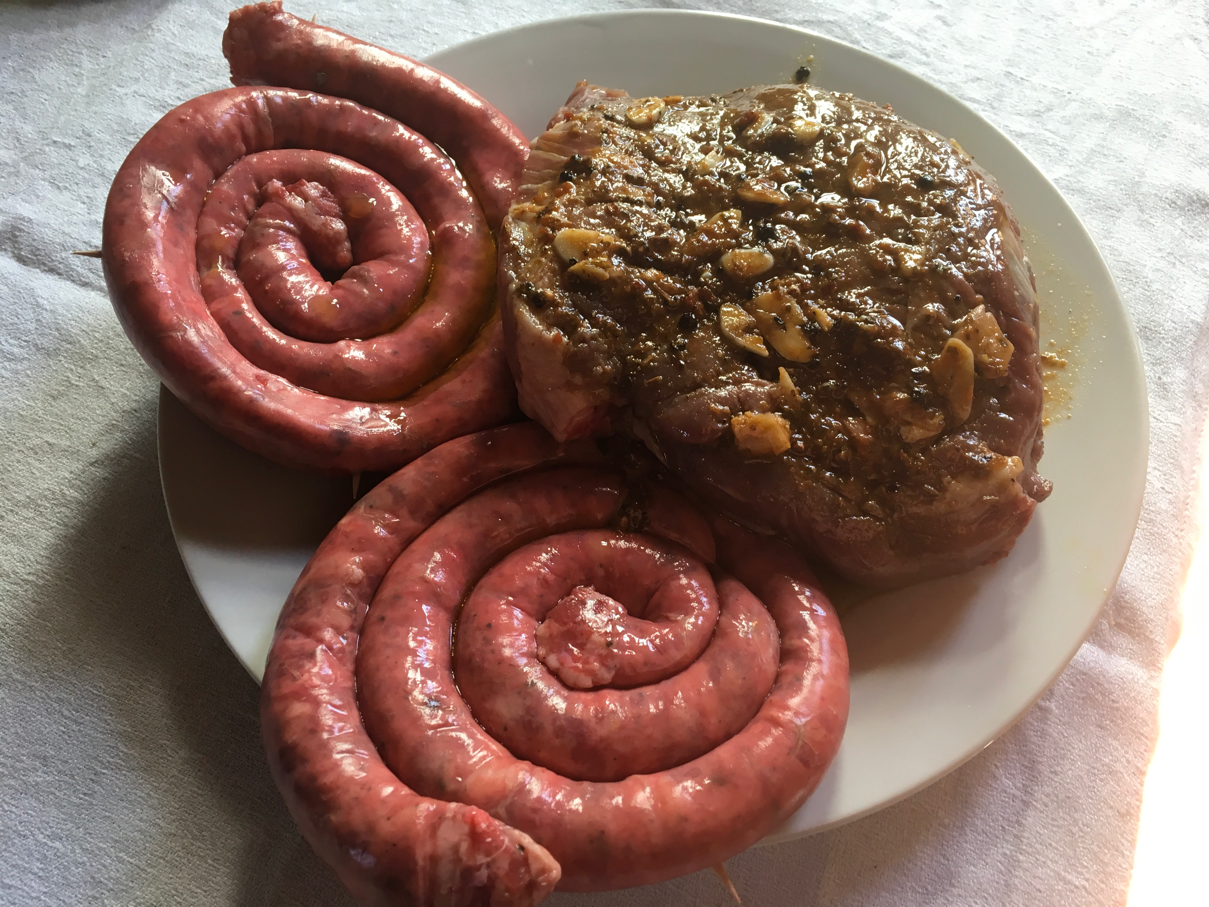
Today we are serving the filet of beef with salchicha parrillera, pinned spirals of sausage grilled for 30 minutes or so. The beef will cook for as long as needed. With this is the mixed salad of lettuce, tomato and red onion. Red chimichurri is essential. 

As is another bottle of Malbec. This time, being on a 6th floor roof, we chose a ‘high altitude’ Mendoza, stunningly delicious from the effect of night-time thermal amplitude. Manuel Louzada of Terrazas de los Andes explained the significance, 
“During the day the plant produces, via photosynthesis, carbohydrates that are taken into the berries. Throughout the night, respiration takes place without photosynthesis, consuming some of the carbohydrates and other organic compounds. The lower the night temperature and, therefore the bigger the thermal amplitude, the lower the amount of these components consumed during respiration, resulting in more intensity of the grape expression due to a bigger richness in the berry of these components, that affect colour, aroma and palate structure.” 
Well, now you know!


Stephanie asks, “Is it the Argentine temperament that makes the asado, or the asado that forms the Argentine ways?”. I look at her lazily and gaze into my half-full glass of Malbec, “Both, I reckon, but right now I am feeling particularly Argentine”.

Maldita Milonga with Lucia y Gerry


It is Wednesday night. For those living in, or visiting San Telmo, this is the night for Maldita Milonga at Peru 571. 

Dressed casually, Moneypenny arrives promptly at 2230 hrs. Today temperatures have reached the mid 30’s and it is still warm from a day of uninterrupted sunshine. Helpfully, a Buenos Aires breeze whips lazy pools of daytime air and spins them into the darkness.

Stephanie and I join Moneypenny on the stairs to descend to Defensa, and then to wind our way through the San Telmo streets, passing cafés, restaurants and bars to which the early night revellers have repaired. There is a softness about the evening. San Telmo is unhurried. Few cars pass, here a taxi sails by looking for a fare, now colectivo 24, then a lone cartonero pushing his trolley of boxes. We walk in silence, soaking up the evening, from an open doorway hearing the sound of jazz, voices laughing, glasses chinking. A jacaranda tree, now almost devoid of purple flowers, is in full leaf swaying gently to what appears to be the same tune.

Maldita Milonga is one of those ‘must-do’s for visitors to Buenos Aires. It is a milonga with a difference: that difference being El Afronte - a very different tango orchestra. Those of my regular readers will recall my blog from November 2015 in which I recorded Sara’s last tanda in Buenos Aires. It was here at Maldita that Sara experienced the full energy of a tango band for the first, and the last time. Her final Facebook post read, “We sat directly in front of four passionate, highly energetic and totally absorbed bandoneon players. I felt as if my whole body was electrified, especially when they played their final Pugliese track, La Yumba! The effects of the powerful live music felt indescribably healing”.


Tonight we are meeting with friends at Maldita. Friendship is a privilege, and few come more handsomely than Lucia and Gerry  They are arguably Buenos Aires’s most authentic tango teachers and delightful people. As tango’s Golden Age came to an end, tango was forced into concealed recesses of ‘underground’ milongas by governments that feared public meetings of any kind. The famous milonguero Oscar Casas managed to collect the reminiscences of old milongueros (teenagers in the late 1940’s and 1950’s), and his set of lunch-time video recordings captured their stories about tango. 

If you go to 6.15 in the Almuerzo Milonguero Part 4 video you will hear reference to ‘La Flaca Lucia’. This is Lucia Seva - who became their very favorite milonguera. Alito says, “She lives and feels the moment” Neli replies, “Yes, that is a milonguera!” What better reason could there be to learn from the only living link that carries the traditions between then and now? 

These days, whilst coaching more experienced tangueros in the ‘milonguero style’, Lucia and Gerry also successfully steer non-dancers and new tangueros on their tango journey to tango competence. As part of the experience, they escort their students to a variety of authentic milongas, of which Maldita is one. 

We join Lucia y Gerry and their students at the table marked ‘Reservado Lucia’ - which is all that is needed in San Telmo. Some students have come straight from their tango lessons in Balcarce. New dancers will be taken to the centre of the pista to get their first feel of a milonga; the more experienced tangueros will be introduced to some of the lesser-known codigos. 

I receive a hug from Gerry, who I first met in 2007 on my extended visit to Buenos Aires. He has an encyclopedic knowledge of the tango orchestras, and one of the larger collections of popular and obscure tangos. Chatting to Gerry takes one back to the 1920’s to1940’s - the golden era of tango music, when orchestras toured the regular salons in the city, and milongueros only ever danced to live music.


Shortly, Gerry and Lucia take to the floor surrounded by coloured marker lights. From a dark corner, Gerry checks with a following tanguero, and receiving a nod of approval to enter the pista. Theirs is not the stage-effect tango of performances; it is keyed to the floor, in close embrace, totally connected and seamless. No show is necessary. The joy of watching is to see tango as it was always danced - and within the milonga, always should be. Within moments, they slip from view. We crane our necks to catch further glimpses, but they have gone, swallowed up by a turning tanda. 

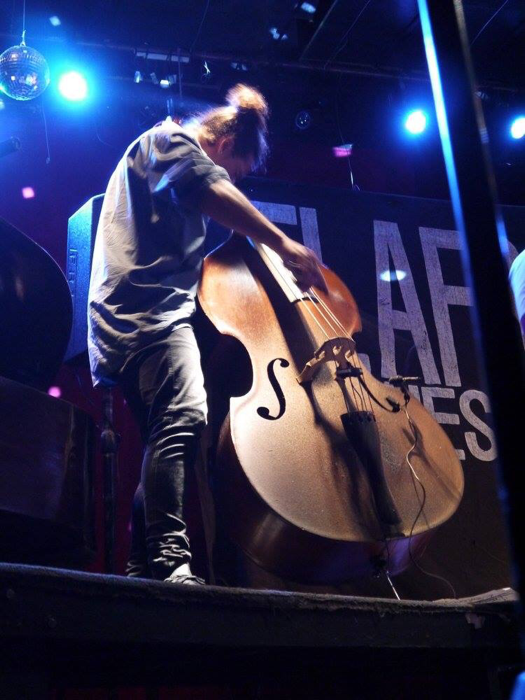
It is now 11pm and movement on the stage behind us foretells the arrival of the orchestra. A tanda finishes; suddenly there is darkness. I count the seconds, then the crash. Lights burst into a host of colours - bright intense, and sallow dark. The shadows are ripped away and there is the orchestra - tonight eight performers, fronted by two bandoneons, with three violins/violas, cello, double bass and piano. Within four more seconds the singer Marco appears. He has sung with the orchestra for over a decade and is an integral part of their sound. 

El Afronte are not for the faint-hearted. Their sound is magnificently aggressive. Each instrument takes its share of percussion, so that their songs pulse with primeval energy. We feel the reverberation through the floor and it rises almost to the chest. Anything that will resonate does so. The bandoneons grind their way, and violins chase to catch up. At the end of the first song dancers take to the floor. Theirs is a different tango - one that expresses angst, sorrow, joy and decision. 


With an emphasis on Pugliese style, this orchestra is not the easiest to mark. Inexperienced dancers find themselves beached during changes of rhythm - or those moments when the music moves from bright-light to dark-obscure. Tango music has always had this quality, but El Afronte magnify the contrast to a point that requires total dance-absorption-awareness. Those that dance well to the performance are those experienced in the dramatic art of tango; accompanied by those who cannot spell the word ‘disinhibition’.  

Stephanie and I watch; but no El Afronte performance would be complete without dancing a tango. We select a quieter song that offers less drama and feel our way out onto the pista. At this moment we sense that we have truly arrived in Buenos Aires. Laura, Maldita’s organiser smiles from the shadows. We hold in close embrace. Stephanie’s Katrinski flats caress the floor. And I breathe in the moment.


We will stay until almost the last tanda played by the DJ following El Afronte’s departure. It is now 2.0 am. We reach the bottom of the staircase and the streets of San Telmo are deserted. Distant is the sound of a siren, wailing on limpid air. I link arms with Stephanie and Moneypenny as we walk the length of Peru towards Independencia and home. 

With thanks to Lucia Seva for the photos

Christmas Day in Buenos Aires


No city is ever silent. At quiet times, they sit and wait; only to burst into momentary flurries of activity at the slightest excuse. 

It’s the morning of Christmas Day in Buenos Aires. The rubbish lorry has just departed, having ground its way along Defensa, the clattering of bottles now receding into the distance. The city’s hum, always present, is this morning the white noise of air conditioners preparing for a drippingly hot day.

Last night was different. Whilst in Europe, cities go wild at New Year in the expectation that the next year will be better than the last, here in Buenos Aires it’s the arrival of Christmas that urges Portenos to ignite their celebratory firecrackers and fireworks. It starts at midnight, or minutes before for those with urging children. At first, just the occasional small flash and bang of a firecracker followed by a puff and smell of spent black powder in the air. Then the turn of the local gatherings, with dozens of fireworks lifting from the centre of each street bathing groups of neighbours in blue and silver light. Eventually, the large civic displays take to the air, and the skyline of Buenos Aires is turned from ink to glitter in a thousand explosive orbs.

The displays go on into the night. At 1245 hrs a huge display erupts from San Lorenz, one of San Telmos’ tiniest streets leading below from Defensa. As each rocket explodes another follows, and for four minutes the sky glistens with coloured sparks and showers.

Retiring from the roof, I pull the shutters to muffle the sound of distant explosions that continue across the city. Below in contrast, harmonious voices of a group of families and friends sing folklorique to the accompaniment of a guitar; and the scent of their asado lifts on a sudden breeze.

Today, it's Christmas. Sparrows chirp, and the resident green parakeets fly boisterously across the roofs. Otherwise, there is a gentleness to the start of the day. A shutter lifts, morning sun flashes on a distant window, an early morning cat sprawls out on a warm ledge. I fold the windows back, sip tea, wait for Stephanie to wake, and the day to begin.


Christmas Eve with Empanadas


The door is open at El Gauchito and Juan leans against the counter. It is like entering a very small cave, enough seats for six or seven ‘flacos’, or four to five ‘gordos’. The tiny room is festooned with photographs and newspaper clippings. Four glass shelves bear piles of freshly made empanadas - carne, pollo, jamon y queso and caprese. Behind the shelves is the counter, and rising above it, steps lead to the place where the empanadas are prepared - ‘empanada heaven’.


Every centimetre of the wall is covered and every shelf crammed. A TV flickers the news in one corner where the wall meets the ceiling. ‘Aladdin’ - alias Nachito, returns for the evening shift. His large athletic frame fills the doorway and a firm hand shoots out in greeting. “Oh, the best empanadas in Buenos Aires? - thanks for the review”. We hug too, for a handshake simply does not convey the importance of the moment. 


Within seconds, our bag of hot empanadas appears from a hand down the stairway, we pay and exit into a street still warm after a hot day, despite the evening air. Independencia is busy with office workers returning from late shopping trips and carrying small parcels. At the corner of Bolivar, seated on a small stool, a street vendor sells posies of cream gardenias from her plastic bucket. Traffic bunches at the junction before flying on to the next set of lights. 

We return to Defensa, climb the 40 or so stairs to our apartment which is now caught in silver moonlight. The rooftop table is set, the Portillo Malbec is aired, and the empanadas are laid out. 

Whilst two forks are set, there is only one way to eat an empanada. Taking a gentle, but firm hold, lift a corner to the mouth, then the bite/suck, followed by a stroke of the chin with the back of the hand to wipe away the juices. The Portillo tastes rich, peppery and full. A single string of Christmas lights twinkle and Stephanie’s eyes flash a moment of satisfaction. 

“Happy Christmas”, I say. ‘What better way to spend a Christmas Eve?”  Stephanie just smiles and lifts yet another empanada to her lips.


San Telmo Diary


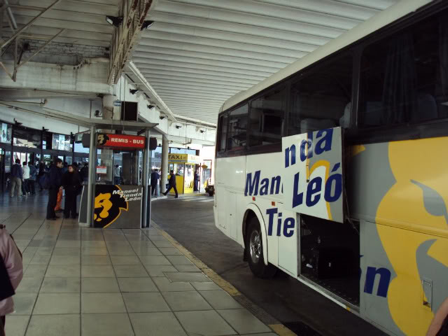
He looks over his glasses and directs a thumb to a screen. Fingermarks register our return visit. He smiles. Without words his eyes say ‘Welcome to Argentina’. Through the ‘nothing to declare’ channel, from the kiosk we buy a Manuel Tienda Leon coach ride from Ezeiza to Buenos Aires, and walk towards the electric doors. 

I look at Stephanie and our eyes meet. We had pictured this moment as one we would recognise: the point of transition between two worlds: leaving Europe and returning to Latin America.

There is something about the moment that is singular. Flight side is busy in a workmanlike way. It is a last refuge, where you may check your luggage, retrieve a purse of pesos or find an address. The doors slide and we pass through to the city side - a new, vibrant, pulsating Latin world of humanity. Tiers of drivers hold placards, some hastily drawn in felt-tip, others boldly announcing corporations; porters rush around with trolleys and cases; families holding flasks of mate are meeting and hugging; police stand in small clusters; voices call; a shrill whistle blows and a surge of taxis and coaches jockey for position on the grid.

Outside the terminal its hot, yet fresh. A light breeze stirs tall palms and blows fallen blooms of purple Jacaranda across the paving. We have arrived.


All vehicles arriving at Ezeiza at some stage must leave. Like other airports around the world, it is after all just a point of transition, its currency being ‘the journey’. But whilst arrival here is simple and seamless, departure is typically Argentine. 

Our coach bustles onto the exit lane. Already horns are sounding, the coach driver shouts at a taxi. Vehicles rush for the exit, each space a small war-zone. Our bulk and the telling dents to the rear off-side carry the day as queues of small cars and taxis snarl behind us. Now the breeze ruffles stretched curtains at the windows and there is a rhythmical chink from the limp workings of the speed limiter as it hangs uselessly against the bulkhead.

On the autopista and through two sets of tolls, we are now heading into the city. Alongside is our strangely familiar Buenos Aires, a city in constant flux with half-built blocks and roofs covered with water tanks and satellite discs. From the raised sections of the carriageway the city stretches interminably, dense, sprawling and compact. Millions of lives are buzzing like small electrical currents and with them, the hustle of city life. We descend from the elevated Autopista 25 de Mayo, turn east in Avenida San Juan onto Paseo Colon. Working our way through the crisis bus-lane road works, we arrive at Retiro. The coach squeezes into the narrow dog's-leg entrance to Manuel Tienda Leon coach stop where we transfer to a little grey taxi, and start our return journey to San Telmo. 


Plaza Dorrego - the final tanda


In a trip to Buenos Aires, you should at least once dance in Plaza Dorrego.

Here in the heart of San Telmo is the most iconic square, where on Sunday nights locals and tourists dance tango under the stars. Pedro ‘El Indio’ Benavente organises the milonga, providing sound system, lighting and a demonstration, and it runs from 7 - 11 pm in the summer months. It is part of what makes San Telmo the tango barrio.

Stephanie and I arrange to meet Miss Moneypenny and TT there after 8 pm. “We will be sitting on the little wall where you change your shoes, or dancing” adds Stephanie; and indeed we are dancing when they arrive from their different barrios. 

With our street shoes tucked inside our bags, and the bags placed securely in the pile next to where Pedro masterminds his playlist, Stephanie and I have squeezed onto the floor for a tanda of Calo. We join dancers of all ages and abilities. Our attention is drawn to a young and energetic couple as they ladle their DNI moves across the polished tiles. Then our discerning eye fixes on a mature couple in their 70’s who dance in close embrace. He gives a clear but sensitive lead, and despite her elderly thickened calfs, she collects her heels perfectly and dances like a dream. They are the prize of the pista. 

We dance a circuit of the floor just before the tanda finishes. For Stephanie, this is like tasting a shard of chocolate from a whole bar, and she wants more. So despite the next tanda being ‘milonga’ - a quicker form of dance - we return starting sedately with Canaro’s Milonga Sentimental. 

I do my best with my new found milonga skills following Patrick Arellano’s instruction, and these are just good enough for the first three tunes of the tanda. A fourth song is fast and the floor has become crowded, so at my request, Stephanie and I step from the pista to resume our places on the wall to watch.

As the final song progresses there is a moment of consternation. Dancers group to one side of the pista. From our position it is impossible to see what transpires. Shortly, we are aware of figures rushing from the southern end of the plaza. The music falters, then stops. Circling dancers stand in couples; and couples in silent groups. They look from side to side questioningly. The non-dancers that crowd and watch from the perimeter of the pista break the moment with animated questions and comments.

Gradually, the pista clears. Tangueros are returning to their places at the edge of the square. A hush descends.

The joy of tango is not simply the mastery of an intricate and difficult dance. It is about a journey within an embrace. Often we hold - or are held by strangers in an intimate embrace, that speaks of a primeval need to be loved, to belong, or at least acknowledged as we go through life.

Tango is a hard journey, through testing times before reaching the goal of fluidity and true connection. For this reason, the skills of young, quick dancers are not the ones that we covet. They are yet to qualify for milonguero status. The older, experienced dancers often hold the key to tango. They take time, in silence they listen to each other and the music, they connect, and they accommodate the moment. And so it is here in Plaza Dorrego. Life, love, anxiety, and intimacy are played out each Sunday as dancers travel to their chosen destination in their own personal tango journey.

Four figures are now kneeling on the ground in concentric focus. There is movement, but little activity. A circle of watchers gathers. Something is amiss. Don Bernabe, the grandfather of this little milonga, speaks quietly with Pedro. He in turn moves forward, but to stop. We hear the sound of a siren as it draws closer on the night air.

The figure on the ground is that of a tanguero of senior age. His polished tango shoes glint in the evening light as he lays. 

Time suffuses and the evening gathers in a surreal envelope. Dancers wait in the shadows, patiently, and expectantly. The expectation is that the figure will rise from the floor. Perhaps he will be helped to a seated position, be assisted to the wall where someone will produce a bottle of water for a much needed drink.

But that expectation is not to be. The figure does not rise, nor now can anyone assist him on this final journey. Even the crowd of tango watchers falls silent. On the far side of the plaza in Defensa, the drumming of the carnival drummers ceases. Plaza Dorrego has never witnessed such silence. People huddle together and whisper. Faces that were intent on dance now look drawn with sadness. A frailty is cast across this place. It is the frailty of life itself. It is - at the end of the final furlong - the end of a journey.

Miss Moneypenny brushes a tear from her eye, and TT places a motherly arm around her shoulder. I pull a shoe lace and reach for my street shoes. Stephanie gathers her bag and folds a wrap close around her. Without words, we walk. I pass Don Bernabe to give him a hug. “This is how life is”, says Pedro Benavente philosophically and without drama.

Back in Defensa we climb four flights of stairs to our rooftop apartment. Moneypenny and TT join us for they sense this moment should be shared, rather than ignored. With a bottle of wine to ease the weight, we sit in the half light and speak of tango, and of mortality.

His was a tango journey that ended as tango journeys should end. Whilst the aftermath is of unimaginable grief, the moment was that of a tango dancer on a tango floor within a close embrace. Together we clink our glasses and wish him 'Godspeed'.


Parque Lezama - the bright side of life and the inevitable destiny


“Where shall we go this afternoon”, said Stephanie, adding quickly, “don’t forget its pizza tonight”. “How about Parque Lezama?” “What a good idea” I rejoin, thinking already of pizza and chilled Lopez.

And so it is to Parque Lezama that we walk, taking the scenic route via Balcarce, Cafe Pride and Cafe Rivas.

An undisclosed, but significant sum of pesos has been invested in Parque Lezama since 2015, turning a tired provincial park into a wonderful work of horticultural art. Sculptures were removed and replaced in polished condition. The children’s play area was relocated from the centre of the park to a convenient (and discrete) lower level. Huge palms were copiced, and have regenerated with succulent growth and a fresh crop of fruit to feed the resident parakeets. Altogether, magnificent.

Today is the day to visit a park. It is 24 degrees, with a light breeze. Overhead there is not a cloud to clutter a 210 degree azure sky, halfway between blue and cyan. The sun shines.

We enter by the amphitheater at Av Brazil on the north side. A lone workman scrubs graffiti from the wall. Perhaps this is his ‘community service’? We mount the steps leading into the main park. To our left the ancients sit at stone tables to play chess and draughts. Ahead white poodles are walked by their owners beneath trees crowned with candy coloured blossom.


We follow an anti clockwise route on the new brick paving, taking in the restored balustrades and enjoying open views. Small plaques to our left indicate the species of tree; ahead - a colonnade set with new benches. Riding slowly on their black bicycles, two policemen pass-by, nodding with appreciation as we give way to their progress. 


Stephanie and I select a bench that still enjoys the afternoon sun, to watch park life. To our right a tai chi figure unfurls a cerise banner, two lovers pass pausing for a long kiss, at one side a group of college students sit together with books spread out on the grass beneath the canopy of a tree. Here is the hum of humanity, gentle, almost gentile. In the distance, the bark of a lone dog, and the sound of a car horn. Then a sudden breath of a breeze lifts Stephanie’s hair and ruffles my collar. This solitary wind is different from others - it signals an altered energy on which the pea-green parakeets have taken flight.

After a while we rise to continue our walk in the park. Just around the corner we see the same two black bicycles stood together on their stands joined by a checkered tape. Two dark figures bend over a pile of clothing on a sunlit bench. One of them reaches down to lift an arm. From the end of the bench dangle two legs with feet clad in old boots. A policeman, with remarkable sensitivity, removes a watch from the wrist, and places it in a tiny pile with other possessions. A blanket covers all but a shock of grey hair. There is no sound; no movement; nor has there been since its discovery. The ‘solitary wind’ now makes sense. That stillness spoke of a moment passing.

Now, children dressed like miniature shopkeepers in long white coats return from school in small groups or with admiring parents. The park springs back into life as the volume switch turns. Contemplative, we walk, hand in hand,  regarding our lives with a fresh value.

“When I die, I want it to be like that”, I say, “On a park bench here in Parque Lezama, in the sunshine, my spirit borne by a flight of green parakeets”, I add. Stephanie smiles. “We will see what we can do”, she says quietly, with a twinkle in her eye.


Oriental Buenos Aires


So, you were expecting a piece about Barrio Chino, Belgrano. But no, we are still very much in San Telmo, just seven blocks in Defensa from Buenos Aires' best kept secret - 'Mash'.

Why come to Buenos Aires to eat curry, you ask? There is no single answer to that. Maybe gorged from the parilla, or piqued by pizza? Perhaps it is simply time to sample something different, with hot spice, chili and fun? Or is it that we seek the quirky, highly individual style of Gus and Martyn who own and run the restaurant called 'Mash'?

We leave our apartment at Defensa to cross Independencia towards Plaza Dorrego. Tonight we shall not linger in the newly restored square with its 2017 vintage-style LED lamps, paving and plastic covered cafe chairs. We hurry by, leaving the restaurant touts and their clipboards in our wake; for our destination is across San Juan, under the fly-over, by Cochabamba towards Juan de Garay. Within minutes we arrive at Defensa 1338, tucked inauspiciously to the left side of the street, announced by two boards bearing the dishes of the day.

Stephanie rings the bell and we glance ahead to see Gus come to the door smiling. How he recognizes us after two years absence is a miracle, but he does, and ushers us in with a hug. Tonight is 'Carnival Tuesday'; the city streets are bare of Portenos and tourists, and the restaurant is unusually quiet. When two regular late dinners leave, we have the place, and the joyful companionship of Gus and Martyn, to ourselves.

Eating at 'Mash' has two attractions. The first, and most obvious, is curry. Yes, there are other curry houses in Buenos Aires that hit the top ten - but their china is too fine, their napkins too large, their glasses too opulent, and their curry too pretentious. At 'Mash' curry is just curry, priced as curry should be, and served without flummery. The other attraction is more fascinating - its to do with Gus and Martyn. 

You can come to 'Mash' to sit quietly in a corner of their restaurant and eat curry. There will be no interruption to your longing looks into your lover's eyes. But, that is not why we are here. We want the rich chemistry, the conversation, the roll of thought and discussion....the perfect adjuncts to curry.

Martyn is the reason for 'Mash', styled as a 'British Curry House'. Born in Dorset, Martyn now lives as a Porteno and has become a living piece of San Telmo folklore. Like all good restaurateurs, he is to be found by the bar with a glass of red wine, a wicked smile and a wonderful flow of conversation. Martyn defines 'Mash' in the same way that Yves Saint Laurent defined French fashion. But being English, he does so with refreshing vernacular British style. Understanding this, and preparing for your curry experience with Martyn is the secret to a successful night. If you arrive damp, dull and devoid of dreams or diablo you may not be allowed in, and if you are, your experience will not be the same as if you arrive hungry for adventure.

Gus by contrast is the Rene from 'Alo Alo' - without the mustache. By day Gus commands huge respect as one of Buenos Aires' most prominent and well known scientists, working as a university professor. It seems strange to see him behind the bar at night, but as he says, "this keeps me in touch with the real world'. His warm intelligence radiates, and arcs with an electric zing to Martyn's acerbic humour..

Stephanie and I choose to sit at the bar, despite 'Carnival Tuesday' tables being free. Why?....because we do not wish to miss a moment of rich conversation that can only happen at the bar stool in 'Mash'. Our orders are placed - Chicken Kashmir and Thai Green Curry, and our placemats are set. We order a bottle of cool, crisp Sauvignon blanc to take the edge off the humid, limpid night.


Those restaurants where you feel 'the embrace' are rare. When found, they are to be prized. 'Mash' is one of these illusive experiences. Soon, Stephanie and I are enthralled by both conversation and wit. It is like taking dinner with two fascinating friends. Of course, conversation is a two-way street, so do not expect simply to be entertained. But if you have something to say, or anything to ask, here at 'Mash' seems precisely the place to do both.

An hour or two later, our plates are cleared from the bar top and we 'down' the remainder of the Sauvignon, with Martyn to our left and Gus to our right. We are but four characters from 'a soap', by now supremely scripted, and very satisfied. At that moment I have a fantasy that conversation should go on until dawn light breaks across the roofs of San Telmo. But that is just my selfish romanticism. Instead, we rise, settle our modest bill, and set off into the San Telmo night.

'Mash', Martyn and Gus have provided another memorable mark in our 2017 Argentine journey. If not before, this is the moment that we feel we have arrived back in our beloved barrio. A colectivo thunders past, gripping the cobbles. Stephanie and I glance at each other with satisfaction and simply stroll back towards the plaza and home.

Thanks to Adasol Oiram for the photo. 

One day - three eras

In the wake of Joe Biden's words about his 'Second Lady', I should acknowledge Stephanie's support for me - not simply with our trip, but also with this blog. She reminds me when I reach a point where my writing stretches meaning, and she comes to the rescue with 'the right word'. So this blog is for her, and for her friends; for it is about pamper and about clothes.

Today was always going to be a special day; for no particular reason other than that was the way it happened. 

After a breakfast of fresh fruit in delicious combinations, we set about our first event of the day: a 'floating feet' pedicure. Whilst in Buenos Aires, regular visits for a pedicure are both affordable and wise.  

Graciela works from Piedras 1025. Piedras is one of those San Telmo roads that planners and time forgot to mark. It happens from - and on the way to - somewhere else; unmemorable and easy to miss. Between a shop and a boarded front, just along from a great rubber tree, is Graciela's doorway, marked only by a number. We push the white bell and wait for her footsteps on the long corridor to the street.

Her studio is small - comprising a couple of interconnecting rooms at the back of the house. A white leather sofa stands by a small counter in the first room; the second being her treatment room. Here is a feeling of Buenos Aires simplicity, frozen in the 1970's, beige tiles to the floor, pale green panels screwed to the walls, a radio cassette player tuned to a local station suspended from the ceiling in one corner. 

Graciela is the queen of pedicures. Hers are not superficial beauty treatments: lasting 30 minutes they comprise total mastery of the feet and are like no other pedicure. Stephanie reaches from her toes to the treatment platform, swinging her legs towards Graciela's roller seat. Within moments, her toe nails are softened and ready to trim, each surface of the foot examined, all rough skin removed and sanded, with attention to the finest detail. As the treatment progresses one feels that a burden is released, a softness achieved, and a stillness attained. Then there is the final massage with cream, and in Stephanie's case, the painting of the toe nails. 

At the end I look to see if she is still awake. Her feet, always pretty, are now more slender, light and beautiful. And so to my turn.

We leave Graciela with a hug and appointments for three weeks hence. Now is time for serious shopping.

Those that follow our 'Twinwoodians' page on Facebook will know about Stephanie's passion for vintage. Together with 'Golden Age' tango, Stephanie's love for the 1930/40's takes us today to Alma Zen Arte at Belcarce 1056. 

Nora is one of those timeless San Telmo women that simply belong in the bario. Her shop is a small cave of vintage, with a slight Parisienne feel. Nora looks quickly at Stephanie and recognises a kindred spirit. "Come this way my dear and let's see what we can find", she says as she leads Stephanie to a rack of 1940's dresses. They are crammed together, in a sort of colour-code, but otherwise random stack. She lifts a pale blue linen dress with patch pockets from the rack. Above and beyond is every dress, skirt, blouse and coat imaginable. They rise in row after row - right up to the vintage wedding dresses against the ceiling. Across the small store are kimonos, and beyond a cabinet stuffed with handbags - this one in dark brown suede with pearl clasps; another in soft black leather with scrolled art deco handles. I sit on a stool and watch Stephanie explore two decades of fashion.

After a visit to Origen, Humberto Primo 599 - cafe con leche served 'French style' in a cup the size of a soup bowl - our still floating feet take us to Maria Jazmin Ropa de Tango at Humberto Primo 558.

The serious tanguera should know about Maria Jazmin. Maria's is my favourite tango shop. It is a place where dreams are made. I sit on the long sofa to watch women arriving in jeans transform into tangueras. Maria designs and makes the clothes. She is tall for a Porteno, with a slim tanguera body. Today she walks in heels elegantly wearing a slimline skirt in black trimmed with lace to the waist. You know when she approves of a choice, her designer's eye fixing and breathing a soft "belissima". This is why Stephanie is one of her favoured customers - she displays Maria's creations perfectly without a lump or bump to be seen. 

We leave, Stephanie clutching a Jazmin bag containing two of Maria's latest designs, one made specially for her. For me it has been a full day of activity. "Now, which milonga tonight?", Stephanie asks.


Freddy's for lunch


On the eve of a birthday trip with Miles to The New Brighton - rated twelfth in TripAdvisor's top restaurants here in Buenos Aires, is it strange to blog about Freddy's?

Saturday afternoon; Stephanie and I walk the length of Bolivar to the mercado, turning left to Carlos Calvo 471. There, nestling under the side of the market, is Nuestra Parilla (otherwise known after it's owner as 'Lo de Freddy').

For this special gastronomic experience it is necessary to be unconditionally hungry and dressed down for street food. Freddy's is not a restaurant, but simply a small incision in the market wall containing six high stools, a shelf, and some of the best cooked beef, pork steaks, and pork sausages in the capital.

Our options, with prices from 25 to 60 pesos, were choripán - chorizo sausage sandwich, morcipán - blood sausage sandwich, bondiola - pork shoulder, or matambre - beef flank steak. We chose the latter, wrapped in crusty white bread, covered in red chimichurri or green garlic and onion sauce, and washed down with a litre of pale Palermo - a light Argentine beer.

Sitting at the shelf with our perfectly cooked hunks of meat, it is easy to see why the word 'matambre' derives from the words 'kill hunger'. To our side, the wall is covered with slips of paper, 'postits' and signed photographs of visitors and patrons. It seems that the whole of the national football team have eaten here at some stage. Each message tells the story of a sated moment of complete satisfaction. Accompanying the food is the floor show, with portenos arriving, departing and simply calling by to chat with Freddy. Outside, a group of San Telmo children play with a market kitten, and an old Ford Falchon rumbles past on the paving sets. 

So, should you find yourself at that point of hunger that requires urgent support - forget the restaurants: make for Freddy's, and enjoy one of Buenos Aires' most evocative gastronomic moments.

San Telmo Sunday

Sunday in Buenos Aires is a most relaxing day. Traffic halves - and slows from a gallop to a trot, particularly the taxis that coast at walking pace looking for fares. Avenida Independencia is almost deserted. Gone are the trucks and deliveries, the pick-up and drop-offs, the honking horns, the blaring radios. Even the colectivos have a relative calm as they slide the calles without racing the lights.

Defensa is closed to vehicles; and is now a sea of humanity - the traders and performers, the ice cream and empanada vendors. On one side hand made jewellery and leather goods are spread out on bright cloths their makers sat on kerbs, low stools or haunches; on the other, the table stalls with deep awnings for shade. Here is every variety of tourist, from North America, Europe, China, Japan and of course the other states of the south. Occasionally, an English voice will penetrate the hubub and we will discretely look away.

Today is the day for a specific search. I descend the calle from Plaza Dorrego, leaving behind the ancient tango performers who have danced together on the same worn piece of hardboard at the same corner for two generations. Their mature daughter joins them now to support and share the performance burden, but the death of just one parent will mean the demise of this particular tradition. The antique stalls give way to tables of scarves, bags, incense burners, carved wooden figures; and to the street performers.

Just beyond Dorrego a slight Porteno in his early 50's breathes life into a wooden puppet which collapses drunkenly against a miniature lamp post. Further, the 'Spirit of Carlos Gardel' stands on a crate to sing. He, like many of the performers, has been at this same spot for decades, his grey hair contrasting with the black brylcreem of a creased Gardel poster.

I pause to greet Alvero, who makes and decorates didgeridoos with Inca patterns and animal designs. He smiles widely and greets me in Castellano. I am yet to see him make a sale, but he always exudes joy and energy. I want to shout to the crowd "Buy a didgeridoo from my friend" until I remember that, for some reason, I too am yet to buy one.

It is after midday and the sun is intense. Passers-by strive for the shaded areas of pavement, others move leisurely between the canopies over the stalls. The older traders display deep indented lines on their dark tanned faces and hands - a sign of their time on the street. To my right now is the parking yard, in weekdays full of cars, but today full of diners sat at small tables eating beef from the parilla. Towards the rear, a band of musiciens folklorique play a zamba.

In Defensa you are never far away from tango - a song, a dance, an apron embellished with the word, the playing of a CD from an open doorway. Later, at Plaza Dorrego, the square will be transformed into an open air milonga, the dancers treading carefully across lose-taped matting to a slow tango or vals.

I slip unnoticed from Defensa turning to my left and into Bolivar, joining again the slow passage of two taxis and a motorcycle. Here, a porteno shakes a mat from a balcony, a dog barks, and a roller shutter grinds to a close. Two young lovers sit on a step, their eyes glued together oblivious of my passing. Ahead, the lights change to green and the rush returns for a just a moment - but like a breath, to be followed by a San Telmo Sunday pause.

Life and food in San Telmo


I am re-posting here a review that I prepared for Fabrizio, the owner of Chacabuco 1181 where I have stayed in 2010, 2011 and 2013. For those visiting San Telmo, this short guide offers a 30 minute or so walk to take in some of the delights of the bario.


"Living at Fabrizio’s, you are in the ideal place to enjoy the features and opportunities of bario San Telmo. Here we propose a short 30 minute walk to familiarise yourself with the neighbourhood, and we will point out places of significance on the way. Note that these are just a small sample of the delights that await discovery here in San Telmo.

Locking the door to the street, and wearing comfortable shoes, turn left in Chacabuco. Three doors down at 1169 is the butchers shop. Although of unlikely appearance, this is the best butcher in the neighbourhood, with excellent meat and helpful staff who will greet you as you pass. For your asado, shop here. Pre-order to get the best cuts, and collect the following day.

Across the road at 1108, before Humberto Primo is Graciela's pedicure. The shop has a narrow front and will be open from 10 am Wednesday to Friday (tel 4300 6789 or cel 15-6700-2479). A pedicure at the time of writing is 90 pesos (excluding a tip of 10 pesos which is customary). If you dance, value your feet, or simply want to pamper, this is the place for you. Tap with a coin on the door to attract attention. For those who do not speak Castillano, sign language is more than adequate, and the treatment lasts 20 minutes. One tip - remove your shoes in the treatment area, and ensure that you do not sit on the raised platform in front of the treatment seat. A second tip - be ready for probably the best treatment you have experienced. Mention ‘Stephen and Stephanie’, and Graciela will be kind to your feet (and to ours!).

Now continue to the junction with Humberto Primo. Should you turn left  (which we shall not do today) you would come to the laundry at the corner (Piedras 1006). For 25 pesos per wash, this is definitely the place to bring your clothes. Ironing is extra, and all of the clothes care is done by the Chinese family. If you call in here, note the vast Ombu tree at the junction.  Just round the corner at Piedras 1176 is an intriguing art studio.


On the right side of Chacabuco and Humberto Primo is your local supermarket (Autoservicio). In truth it is a small self-service shop run by a pleasant Chinese man, with separate fruit stall positioned at the doorway run by two Argentine sisters. Whilst it may be unprepossessing, it is my favourite, with a selection of basics and wines at reasonable prices (compared with Carrefour in Peru). You have to travel some distance to better it. The cost of your shopping will be added up on a large calculator and shown to you. This is a safe shop where your custom will be valued, and you will be helped with your change.

On the opposite corner of Chacabuco (Humberto Primo 689) is Moderna Pizza. I have to say that I have a fondness for this place (which stays open to about midnight). The empanadas may not be the best, but the pizzas and tostados on the other hand, are excellent. Order the medium size pizza for two, and try a glass of Malbec or a bottle of Quilmes. Pizzas here cost about 70 pesos. The staff are very friendly and will greet you on your return visits.

From Moderna, we descend Humberto Primo. Stay on the left side, passing Roli cafe at the corner of Peru, run by Manuel who always wears his spectacles on his head! To your left round the corner in Peru 1085 is Cosas Ricas, a bakery. This is a good place to buy medialunas, bread, cakes and tortes, and is usefully open on Sunday mornings when other bakeries are closed. Mid-week they also serve delicious boxes of salads. If you are prepared to wait seek out Diego, the young male assistant with the smile, who teaches English. At busy times, don't forget to take a ticket from the dispenser, or your wait may be long.

Opposite across Peru is Origen (Humberto Primo 599), a delightful breakfast venue where you can sit inside, or at the pavement to watch the San Telmo world. Breakfast coffee, fresh juice, and tostados with jam and cream costs 59 pesos and is the best way to start the day. The waitresses only speak Castillano, but this is never a problem. For lunch or an evening meal before the milonga, try one of the woks - delicious and sustaining.

For this walk, we shall not remain in Peru (a delightful street with Itame Sushi bar at the opposite corner (1112), and an architecturally interesting local police station just further down on the right in the direction of Carlos Calvo). We shall continue past Origen in Humberto Primo towards the next street, Bolivar.

Stay on the left side and note the Arab restaurant Habibi (Humberto Primo 523) as a fun place for a cosy night out with spicy food, and continue to Bolivar. On the right corner at Bolivar 1101 is Caracol, a very popular cafe with locals for Sunday lunch. Had we gone straight ahead towards Plaza Dorrego we would have passed the tiny Guebara in Humberto Primo 463, a bar for jazz and beer. Ask for the draft - it is only a few pesos, grab a chair if there is one, and listen to the band. But, on this occasion, we shall cross into the San Telmo mercado. Arguably the most famous market in Buenos Aires, this mercado combines fruit, vegetables, meat, cheese and snacks, with antiques. Wander at will, and take a break on one of the tall stools at Cafe del Mercado in the centre, sample a deep-fried empanada; or try the best coffee at Coffee Town and watch the theatre of the market. Take time to glance up at the roof, and amble through the market stalls to Defensa. Here, turn right up towards Plaza Dorrego.

Solar_de_French_in_San_Telmo.jpg
We are not to stay today, but will continue up Defensa in the direction of San Juan (towards 1000-2000) looking for Pasaje de la Defensa at 1179 on the right side of the road. Enter here, and browse the antique shops and cafés, ensuring that you take the stairs to the first floor gallery for the view and photos down into the courtyard.

We shall continue our walk on towards San Juan. …..Note that were you to continue across San Juan you would eventually reach Parq Lezama, flanked by the famous twin cafés Britanico and Hipopotamo…... But that is for another day. For this walk, we turn from Defensa left into San Juan, noting over to your right Café San Juan, the extremely popular french restaurant (San Juan 452 - tel 4300 1112 booking essential) and opposite at 451, step down into El Maipu, run by a delightful young couple (an excellent place for marinated pork).

Take the next left into Balcarce. This is my favourite street in this section of San Telmo. When you reach the junction with Humberto Primo, detour twenty paces to your left to 340, to photo the Parroquia de San Pedro Telmo, a stunning neo colonial church. Afterwards, retrace your steps to Balcarce and continue left downhill.  Call into Galerio de Viejo Hotel (1053) on the left - tour the balcony ateliers, and on the ground floor try the café El Patio de Cabo Verde for a quiet snack. Leaving, pop across the road to Alma Zen Arte at 1056 for genuine period clothing from 1920-60. For a quiet lunch or early evening meal remember Pasaje Solar (1024) which features a gorgeous shaded courtyard away from the noise of San Telmo. At the junction with Carlos Calvo, turn right and brave the 'yet to be paved' tail end of the street where on the right you will find Celine (242), a French cafe open evenings only (tel 4361 1269 to book) with a superb 1st floor terrace overlooking the picturesque German church. This is the place for early evening drinks on warm evenings (but take a shawl should the breeze lift). Retrace your steps back to cross Balcarce. Ahead at Carlos Calvo 319 is Antigua Casa de Cuchilleros (tel 4300 5798 to book) which offers Grand Parrillada for 225 pesos for two people. Then back to Balcarce, descending yet again. If you are vegetarian, note at 958 Naturaleza Sabia - run by enthusiastic veggies (tel 4361 1549 to book). Take a look in La Celina at 922 for interesting crafts and weavings. The candles you were looking for are available from Maria Jose Gomez at Prema, Balcarce 914, on the opposite corner at Estados Unidos 302 (tel 4361 5529 to book) is Cafe Rivas, a delightful restaurant with simple menu and excellent reputation. Two gorgeous cafe con leche and a shared cake will cost 55 pesos - worth the price just for the charming environment and excellent service. If you are seeking a very private triste, pop up to the gallery via the stairs near the door!

Turn left in Estados Unidos (another favourite street), to find Vinotango at 488, a useful wine shop run by Juan, who sings tango songs to his customers and speaks perfect English. Juan and his mother will give excellent advice on what wines to try. Crossing Defensa to Yauss Club at 509 - (formerly Waffles Sur) operated by Javier and his pretty girlfriend Valentina. Opening times here can be a lottery but try the breakfast waffle with bacon, scrambled egg, salad drizzled with honey. Together with coffee and fresh juice they make an excellent start to the day. Just a little further up Estados Unidos at 617 is Walrus Books (www.facebook.com/WalrusBooks.BA) - worth a mention because all of their stock is in English. Before you leave San Telmo, make sure you drop of your unwanted paperbacks here as a gift for the proprietor, and mention that you are staying at Fabrizios.

We shall turn left, back into Bolivar just in time to book a seat at Fellini at 933 (tel 4361 4679 to book). The  family serve a set meal  involving 14 dishes! For the full description of this terrific, favourite restaurant (formerly Maria Fedele), visit my blog at Stephen Twist Tango. Whilst returning up Bolivar, note Pedro Telmo, the cafe under the market at 962. This is one of the oldest original cafes in San Telmo - skip the main meals, but it worth a visit for pizza and beer or glass of wine. In the day, see the 80+ year old Manuela and give her a gentle hug, and at night greet Horacio, the larger-than-life waiter. We return we miss Antonnino at Bolivar 1087 - which used to be the one place locally to buy fresh or prepared fish. Now you will need to track out to Defin at Azara 99 -  a 19 minute walk down Tacuari, crossing Av Martin Garcia). So to continue, back to Humberto Primo, where we turn right towards Chacabuco.

On your return to Fabrizios, turn right to Dylan Ice Cream Parlour at Peru 1086.  As you may know, Portenos take their ice cream seriously, and you will need a half litre tub at least, perhaps with a triple mix, to take back with you to share at Fabrizios".

If you wish to contact Fabrizio for accommodation in his shared house at Chacabuco 1181, email fabymari@gmail.com