Showing posts with label Argentina. Show all posts

Estados Unidos


Calle Estados Unidos is a fascinating street of Buenos Aires. If we follow it out to the west beyond barrio Caballito, our tree-lined calle fades into calle Valle, only to end abruptly eighteen blocks later at calle Miró (just short of LaBaldosa Milonga). 

But, for the purpose of our adventure we shall walk east taking us on a journey through Boedo, Monserrat, San Telmo and finally into Puerto Madero.


Following the defeat of the 'Unitarians' by the 'Federals' in 1820, the new ‘United Provinces of the Rio de la Plata’ was recognised by the USA, and Calle Estados Unidos was later named in their honour. 

It is one of the city’s greener streets bearing jacaranda and tipuana tipu trees along its length. In spring and autumn the pavements glow with pink and yellow petals. With a relaxed feel, preserved architecture, and an intimacy, it presents as a favourite street to walk.

Save for the inexplicable dog-leg at Riobamba, Estados Unidos is a straight, one-way grid road running west to east bringing light traffic into the city. It is sandwiched between the busy east to west roads of Independencia and Carlos Calvo which take traffic from the centre. On the whole, incoming traffic seems to prefer the more versatile roads of Chile to the north and San Juan with its wide open carriageway to the south.

Estados Unidos is unremarkable before we reach Av Boedo, where the street passes one block to the north of DeQuerusa Milonga at Carlos Calvo 3745, skirting the gardens of Plaza Mariano Boedo, and running three blocks north of Club Gricel Milonga at La Rioja 1184.


At Pres Luis Saenez Pena you are but one block from Casa Bella (Independencia 1502), a worthy detour to an emporium selling everything from a portable BBQ to a full size asado.

Estados Unidos becomes more interesting once across 9 de Julio (the widest avenida in Buenos Aires) as you enter barrio San Telmo. Passing the small park of Plaza Concepcion del Alto de San Pedor, the street narrows and cobbles replace tarmac.

At Tacuari 905 is our first San Telmo milonga ‘Chanta 4’, and at Estados Unidos 802 you will encounter the Museo Argentino del Titere (puppet museum).

A stop at Estados Unidos 617 is a must. Here you will find Walrus Books, one of the more interesting stores in Buenos Aires, stocking the widest selection of foreign books in the city.


Further on look out for the street art at 553 and proceed down to Peru, where a few steps right will take you to The Gibraltar at 895, a very popular San Telmo pub. Thirst quenched, continue on to La Brigada at 465.


La Brigada is said to be one of the best steak restaurants in Buenos Aires, combining eating with football. But this place is no slouch. Booking is essential, as is a well-charged credit card. It is all worth the effort and expense, setting almost unattainable standards of cuisine and service for its rivals.

Across the road from La Brigada is the Mercado de San Telmo, the city’s most iconic covered market containing restaurants, cafes, antiques, hardware, grocers and butchers.

Freddo (Defensa 901) might prove to be a suitable stop for ice cream, but for morning coffee, lunch or afternoon cocktails continue down to Café Rivas at 302. This has to be a favourite for those visiting San Telmo. Intimate, smart and friendly, Café Rivas ticks all boxes for those seeking a midday snack or full evening meal. For vegetarians, continue down to Balcarce, turn right to 958 where you will find Naturaleza Sabia.


Beyond Balcarce, Estados Unidos descends to Av Paseo Colon with the dramatic frontage of the Engineering faculty on your left and the gorgeous Ministry of Agroindustry to the right. Walking between them leads you towards Av Alicia Moreau de Justo, the gateway to Puerto Madero where Estados Unidos gives way to Rosario Vera Penaloza and the Rio Darsena Sur.


All you need to know about tango in Buenos Aires


Readers have asked for some guidance on tango in Buenos Aires - where to learn, where to dance. 

What a seriously difficult task I have been set. 

Let me start by identifying the problem, and only then will I propose a handful of solutions. I am simply a tanguero on my personal tango journey, which may be very different from those of my readers. And I will almost certainly miss more than I cover.  So here is your task. Should I neglect your favourite location,  milonga or teacher, just add details in the comments section below.

Note too that tango in Buenos Aires changes from day to day. 

My first visit to Buenos Aires was in the heady days of Confiteria Ideal at Suipacha 384, El Arranque at Bartolome Mitre 1759, Cachirulo at Maipu 444, Centro Region Leonesa at Humberto Primo 1462. Who would have thought they would ever close and that the El Arranque milongueros would become too old to dance? Venues come and go, turned into hotels or offices. With them, the milongas disappear, some to be revived in different locations by new organisers, inevitably with changed codigos and a different feel. Teachers, once supreme, become too old to teach, and others who were but children, now reign supreme.

Each tanguero (and would-be tanguero) has a different tango taste. Some find themselves in milonga heaven when dancing with the old milongueros in milonguero style, others are committed to strictly salon tango and its technique, and there are those that want to stretch their tango aerobically with tones of nuevo; with all of the tango tastes in between.

Stephanie and I are becoming more comfortable with milonguero style, but our hearts remain in salon tango, as danced in the Tango Mundial. To an extent this will influence our choices here.


Beginner tango in Buenos Aires
If you have never learned to dance Argentine tango before your visit, getting started can be daunting. It can also be fatal. An inappropriate tango methodology, or the wrong tango teacher can spoil or ruin your personal tango journey, maybe instilling bad tango technique, and at worst causing you to give up on the task. 

Beginners in Buenos Aires should look no further than Lucia y Gerry  Lucia, known historically as the milonguers’s favourite follower is at the top of her game. They provide reasonably priced private tango lessons for beginners that are not simply about the steps, but encompass your whole tango journey. With them, you will learn about the structure of tango, its codigos, where to dance, and even be taken to a milonga for your first tango adventure. Check out their reviews and awards by following the Trip Adviser link above.

Beginners should also take advantage of the tango classes that precede the milongas. A quick check of Hoy Milonga will show which are available. Here, you will never learn good technique, or indeed how to dance tango with skill, but you will meet new friends that share your passion and can accompany you to milongas.


Beginners and Intermediate tangueros
Yes, I know what you are thinking. What is an intermediate tanguero? When do you become one, or stop being a beginner? Well, actually, there is no answer to this. With intuitive skill and lots of practice it is possible to advance quickly in tango, and some that have danced tango for a decade remain long term ‘beginners’. 

For both beginners and intermediate dancers, the rules are the same.

First and foremost, find a great teacher, then stick with him or her for the duration of your visit. Here, I shall not be recommending particular teachers, for the choice is massively dependent on one’s age, aptitude, preferred method of learning, tango aspiration, personality type and tango style.

There are two great ways to identify ‘your teacher’. Some tango tourists have found a visiting teacher in the USA or Europe. Others have their favourites from YouTube. My recommendation for those that have yet to find a teacher is to visit the principal tango schools here in Buenos Aires and to take a group lesson with different teachers. If you are living in Palermo, especially for younger dancers, visit DNI  In the microcentre, you cannot beat Escuela de Tango de Buenos Aires  with the widest range of classes throughout the day from a variety of top teachers. Should you be staying in San Telmo, Carolina Bonaventura’s Marieposita de San Telmo tango school offers a great starting and finishing place for your tango journey.

Whilst on the topic of tango teaching, it is important that I mention tango music. Those hearing ‘Golden Age’ tango music for the first time frequently describe it as alien scratchy and incomprehensible. It is, after all, from another age. But Golden Age tango is ubiquitous here in Buenos Aires both in the milongas and on the street, and you must understand it before you can properly dance to it. 

My advice is to listen to as much Golden Age tango music as you can before you visit Buenos Aires. Ideally, you should be able to distinguish between the orchestras - the distinctive sounds of Canaro, Biagi, D’Arienzo and Fresedo. You should have worked out the structure of the songs, and better still, understood the words. Listen and learn the full names of the principal orchestra leaders,  their singers, and when the recordings were made. This will help you to develop tango musicality - the key to dancing tango. You will discover that different parts of a tango bring a different mood to your dancing, just as dancing to each instrument may take you on a changed tango journey. Here, I highly recommend Michael Lavoca’s fascinating book.

Milongas
I have already mentioned Hoy Milonga - the essential app that you will need for your visit. Use it to find milongas, their locations and how to get to them. It is kept up-to-date and is mostly reliable, although milongas can be cancelled at short notice, or disappear overnight.

The number of traditional venues has reduced, but the variety of milongas still remains rich. 

The main salons and tango clubs, including the ‘must do’ list are:

Salon Canning, Scalabrini Ortez 1331
The most iconic tango venue in Buenos Aires, known for its smart set and tango performances. It tends to be crowded, so be prepared to dance on a tile.

La Viruta, Asociación Armenia, Armenia 1336
If you happen to be under 40 years old (and even if you don’t), Friday and Saturday nights here are a lot of fun. Siesta beforehand and stay until 6 am to see the professional dancers when they arrive from other milongas

El Beso, Riobamba 416
A personal favourite, especially those of Eli Spivak,  with a variety of afternoon and evening milongas offering quality dances in milonguero style

La National, Associazione Nazionale Italiana, Adolfo Alsina 1465
Hosts a range of milongas that have gravitated from other locations, now housed in a gorgeous salon with a great floor

Obelisco, Entre Rios 1056
Popular, modern salon hosting a number of milongas throughout the week. Not my favourite, as the cabeceo/mirada is difficult here, but many love it.

Villa Malcolm, Cordoba 5064
Choose the right night to see the young, fast performers practice for their next exhibition. Choose the wrong night and sit with the aged.

Lo de Celia Tango Club, Humberto Primo 1783
I love this milonga - friendly, traditional and relaxing to dance

Club Gricel, La Rioja 1180
A popular place to dance in milonguero style, with a degree of formality of codigos

Nuevo Chique, Asociación Casa de Galicia, San Jose 224
A delightful little location, with a very popular milonga for tangueros at every level

Maldita Milonga, Peru 571
Wednesday night is El Affronte night - when an orchestra of 10 musicians will introduce you to the dark side of tango. Lots of fun as an event, but stay on for the best feel after the non-dancing tourists have left at 1.00 am.

La Catedral, Sarmiento 4006
Attracting tourists and beginners to practice their steps, and with a questionable floor, this is a ‘must-see’ place, simply because it is so unusual.

La Glorieta, Echeverria 1800
Open air milonga in a big bandstand. Not a high standard of dancing, but a very romantic location.

Plaza Dorrego, Defensa 1100
My favourite open air milonga. Don’t wear your best dance shoes, and avoid taking a bag, but this has to be part of your tango journey whilst in Buenos Aires.

De Querusa, Carlos Calvo 3745
A personal favourite attracting a range of age groups, and many better dancers of the salon tango style. 

Bar los Laureles, Av Gral Iriarte 2300
If you have the time to do this in your visit, book a table, come to eat pizza, pasta and budin de pan, and dance on the small floor of Buenos Aires’ oldest tango cafe. It will re-define your love of tango. Choose the tango dance nights.

El Tacuari, Tacuari 1557
Little milongas like El Tacuari exist all over Buenos Aires. Many can be fun for a night, and some may become your tango home during your stay. The art is to ask other tangueros where they go, and to follow them there.

Your tango journey
Your visit to Buenos Aires will almost certainly re-define and refine your personal tango journey, helping you to mature as a tanguero. You may (as did I in 2007) arrive with a love of nuevo tango music and leave with an obsession for Golden Age. 

Importantly, come with a truly open mind. Forget preconceptions absorbed from dancing tango elsewhere in the world or watching professional dancers. Tango in Buenos Aires is not really about either of these. It is owned by the Portenos that dance it day-in and day-out. It is managed by the cordigos that you will need to learn and respect. It is a living, organic dance that is defined by the embrace, the music, the mood, and the feel. It is danced on a floor with feet that rarely leave it.

If I were asked to sum up my tango check-list learned over eleven years and 30 months of dancing in Buenos Aires, it is this:
  • Respect the traditions - they are not restrictive - they are what allows tango to develop and remain the most fascinating dance genre
  • Use the cabeceo and mirada - without it you are simply a tourist to be avoided
  • Perfect your embrace - with the right embrace, you may be forgiven all of your other shortcomings
  • Concentrate on musicality rather than steps - any fool can learn steps
  • Leaders - always respect the pista, the lanes, your partner and lead her from the pista
  • Followers - relax and have fun - your mood will be infectious
So, that’s simple isn’t it? I would love to hear from readers that are able to take anything from this post - what worked; what didn’t; what was most valuable; what I missed or should be corrected. 

Leave a comment on the post below, or message me via email or Facebook/Messenger. And have a great tango trip.


Buenos Aires - ‘the long stay’


After enjoying temperatures in the upper 20’s and lower 30’s, this week they have plummeted to a chilly 24 degrees centigrade, with a light bright breeze and today unusually, an overcast sky.

Stephanie and I have been here in Buenos Aires since early December, and have now entered our last week. Coming to the end of the trip, some of you have asked how it feels to have been away four months. In particular you have asked about the merits of longer stays abroad; winter in the southern hemisphere; and the prospect of a return home after an extended time away. 

With the change of season the time seems right to reflect back and share our thoughts on our Buenos Aires sojourn.

We have loved wintering in Argentina, but for it to be successful you need to address three principal issues. 


The first is ‘opportunity’. 

Working full-time, the prospect of taking three or four months holiday in one go is problematic, but not impossible. Ideally you need to be rich, self-employed, fully or semi-retired, but requesting sabbatical leave is another possibility, and was the gateway for my first trip to Buenos Aires eleven years ago.

Some of you may have other responsibilities that you see as precluding a longer trip. I have addressed these concerns in a previous blog - with thought and planning they can often be managed at a distance for an extended stay. Frequently having ‘other responsibilities’ is simply an excuse not to take - or to defer - an extended trip.

The next issue is ‘cost’. 

After several trips to Buenos Aires using different airlines, Stephanie and I now simply book a direct British Airways flight from Heathrow, at an individual return cost of 900 pounds. For a journey of 7,000 miles the flight time is inevitably long, so a direct flight is our preferred option. It is possible to source cheaper, indirect flights from London to Buenos Aires, but be warned - those that go via the USA are long, stressful, and require the USA visa (ESTA) to enter and exit even for connecting flights. A further option is to travel London-Paris/Madrid- Buenos Aires, but the saving still leaves a sizeable ticket price. 

Once cheap in Buenos Aires, the cost of accommodation now approaches European prices, so the longer the stay, the more prohibitive the bill. Stephanie and I mitigate this by renting an apartment in the city, driving a preferential deal for an extended stay. Nevertheless, we recommend allowing $50 US per night for accommodation - $350 per week (250 pounds sterling).

The cost of living has risen substantially over the last decade here in Buenos Aires. Ten years ago we received 4-6 pesos in exchange for 1 pound sterling. Today, the Azimo rate (arguably the best way to receive cash here) is 26.97 pesos to the pound. Yet inflation costs have risen so dramatically over the years that your peso buys much less with many prices similar to those in the USA and Europe. That said, wine and beef are a lot cheaper, as is eating out, and of course you don’t face the winter fuel bills.


The third issue is ‘imagination and lifestyle’. 

If you put your mind to it you can come up with a thousand reasons why you should not take long-stay trips. But for Stephanie and me, ‘the long escape’ offers opportunities for a different, varied and exciting lifestyle, with new friends, experiencing a new culture - and of course, enjoying a second summer.

Climate and culture provide the two best reasons to make Buenos Aires as a choice for an extended stay. A smattering of Spanish language helps, but is not essential for Buenos Aires remains the most European of cities in South America by way of outlook. 

Life after a ‘long-stay’ - returning home.

Of course, we are yet to return to the UK, but this is our fourth successive ‘long-stay’ in Buenos Aires so we can make comment on life after Buenos Aires.

Returning home is always difficult. Arctic temperatures in London and the North, and the news from the UK, do not impell return. Yet, a benefit of ‘the long-stay’ is the chance to review with fresh eyes the things you appreciate about home, and the changes you may want to make.

The one inevitability of the long-stay is that the experience does change your outlook. You don’t return as the same person that left months earlier. Your consciousness is enriched, as is your understanding of other people. That is why, whether young, old (or somewhere in between) you should try to find time to travel and, where possible, take the ‘long-stay’.


Mindfulness, awareness and tango


Jon Kabat-Zinn, pioneer of modern mindfulness, says that mindfulness is “a form of meditation”. “To be mindful is to be aware”, he says, “it is to be acutely aware of the here and now, of your sensory perception, of your breathing and of the sounds around you. It’s an awareness of the feel... of the floor’s touch on the soles of your feet, and of the quiet”.

Before I danced Argentine tango I was a ‘feel-aware’ sceptic. Touchy-feely nonsense of mindfulness? What was that? Yet Kabat-Zinn's definition of mindfulness is in fact a perfect description of Argentine tango.

Argentine tango is very different from ballroom tango that you may have seen on BBC's ‘Strictly’ or USA's ‘Dancing with the Stars’- just as chess is different from dominoes. Argentine teachers struggle teach ballroom and Latin dancers, their torsos leaning from their axis and who regard the floor as something to be ‘crossed’, rather than ‘possessed’.

In Argentine tango, the floor is the vital, grounding, mindful element of the dance - ‘the feel of the floor on the soles of your feet’ being the first tango lesson. The tanguero learns to walk like a panther, pressing their feet into the floor, stepping onto the toe or heel, but instantly descending to the ball in a mindful moment of arrival.


A further dimension of mindfulness is found in the ‘partner relationship’.

It is a tradition of tango that you will dance with many other tangueros at a milonga (the social dance) - some known, others as strangers. A ‘tanda’ - three or four consecutive dances that are danced with the same partner - starts with an ‘embrace’, essential to develop the outwardly imperceptible lead and follow. In the course of the tanda you may get to know a stranger's name if between songs, you ask; and maybe where they are from if you share a language. But at the end of the tanda, still as strangers, you part with a mindful awareness of each other's presence through the shared experience of dance.

During the first song of a tanda, a leader will dance simply, gauging their partner’s balance and mass, their skill, experience and capacity, their responses and preferences. In the course of the remaining songs, the dance develops in complexity, dictated by the music, its rhythm and structure. As different instruments of the orchestra emerge, the lead may switch from the basic rhythm to the solo instruments or singer, changing both mood and storyline of the dance.

Whilst some professional tango dancers perform to non-tango music (and inexperienced tango dancers seek to emulate them), Argentine tango should be danced to tango music. At the turn of the last century tango arrived with migrants to Buenos Aires and Montevideo, and they created a unique dance to accompany it. Tango songs have a particular structure, one of which experienced dancers are mindful, and one that creates an essential ingredient of mindfulness.

The music is crucially important, just as is the capacity to recognise, understand and interpret the different orchestras. A tanda of 'Biagi' will have a different quality and feeling from that of 'Fresedo'. Played by a live orchestra, tango will offer different possibilities compared with a recorded version. True tangueros never neglect the difference they feel as they listen to the music; they are totally mindful of its power and significance.


The ‘embrace’ is also unique to tango. Tangueros close their embrace and the magic mindfulness happens within it. An observer will see the footwork, perhaps playfulness, or challenge - but rarely penetrate the feeling that exists within the embrace. In social tango this is a completely private moment, experienced and understood by the embracing dancers. It can be enormously powerful, involving a connection of mindfulness that exists only within tango. 

The final element of tango mindfulness is ‘the moment’. A ‘tanda’ presents a journey. Yet that journey is not conceived or understood at the outset, nor indeed during it. Tangueros live in the moment. It may be a moment of silence, of stillness; or a giro (turn); a sacada (possession of axis), a boleo (removal from axis) - all unchoreographed moments in which the tanguero transitions seamlessly from one moment to the  next.

When you next think of sitting and being mindful, doing nothing apart from contemplating your own awareness, why not simply dance tango? It will certainly be better for you, and you may indeed enjoy it. But mind, the mindfulness of tango is addictive and you may forever chase that ‘perfect mindful tango moment’.


Milonga de Juan


Milongas: after years of survival of the fittest, even some of the survivors have disappeared. Confiteria Ideal at Suipacha 384, El Arranque at Bartolome Mitre 1759, Centro Region Leonesa at Humberto Primo 1462,  Milonga La Nacional at Adolfo Alsina 1465 - who would have thought that they would ever close?

But milongas still survive and thrive at Associazione Nazionale Italiana, Adolfo Alsina 1465, a location that has inherited Yira Yira and Los Consagrados from Humberto Primo. A new event here is Milonga de Juan, held each Wednesday afternoon from 3 - 9 pm.

Stephanie and I arrive just after 4 pm and are led to the prime table in the centre of the front row across the pista from the bar and backing the stage. Tonight, organiser Juan Angel Rosales is not present, so his tasks have been delegated to assistants. The salon is animated, but lightly populated, giving room to extend and to dance.

There is something special about afternoon milongas, particularly those in Buenos Aires. The atmosphere is more relaxed, with a feeling of fun. They are more recreational and less intense than their evening counterparts. Of course, they attract a different clientele - clearly those that do not work on a Wednesday afternoon. That said, with the welcome addition of tango tourists, the demography is not ancient - let us say, ‘simply mature’.

To feel our way into a milonga, Stephanie and I dance the first tanda with each other. It happens to be our favourite vals. An advantage of dancing together at the outset is that it presents us and our respective skill sets to watching tangueros, who then discern whether or not to cabeceo and mirada either of us for subsequent tandas. In this regard we need not have been concerned, for as the afternoon unfurled, we danced almost continuously.

A feature ot Milonga de Juan was just how friendly the regular attenders were, and how accommodating to us as tourists. At several points in the afternoon, local tangueros came to chat and share a moment of their time. 

For those looking for an afternoon milonga, look no further. Milonga de Juan is a great and well needed addition to the milonga circuit and should feature on your list of places to dance when you next visit Buenos Aires.


Return to Feria de los Mataderos


Assiduous followers of this blog will remember my last trip to the feria in November 2013. It is time for our return visit, today a romantic trip for Stephanie and me, our friends who were to accompany us have drunk too much wine in their jacuzzi last night.

Topping up the Sube card in Independencia, a stroll to Bolivar/Chile takes us five minutes; thence to board colectivo 126 which runs the 51 stops over 14 kilometers right out to the feria.

I should tell about the colectivos for those not familiar with the transport system here in Buenos Aires. ‘Colectivos’ are the public buses that cover every part of the city. Radiating out from the centre and initially sharing routes, they gradually gain exclusivity as they reach the outer barrios. Linea 126 starts at the APM terminal at the port district beyond Retiro, and runs via Monserrat, San Telmo, Caballito, Floresta, Parque Avellanida to Mataderos, terminating a few kilometers beyond at Cementerio Armenio de San Justo. Our Sunday journey will take just over an hour. The cost 6.75 pesos each way.

In el centro, the colectivos rush down one-way calles and avenidas between traffic lights, slowing only for the deep storm drains at intersections. Once out of the central barrios, still within the urban sprawl, our colectivo maintains a central lane, careering to the near side only when a passenger pushes the bell. With a split second to avoid collision, taxis, cars and trucks grind to a halt behind, only the motorcycles managing to swerve to maintain their progress.

As we reach Av Juan Bautista Alberdi we hit the cobbles - not the bone-wrecking type of San Telmo - but deep sets worn smooth by decades of traffic, providing a percussive drumming as we speed to our destination. The cobbles are as British as the rail terminals, old docks and post boxes here in Buenos Aires, for they were ballast in the holds of English ships arriving to collect Argentine beef. As we progress, the bus flashes with bright reflected sunlight from passing shop windows.

We reach Directorio 6000, and know that the feria is our next stop by the Anfiteatro de Mataderos and Skatepark to our left. The few passengers that remain decant into a sundrenched street. As five years ago, there is a hunger-inducing smell of parrillas on the morning air as asadores tend white bloomed charcoal in drums and long trays piled with cooked sausages and every cut of beef. 

Access to the feria is via Av Lisandro de la Torre, a wide avenida that is soon cut by barriers, indicating the start of the market. As we approach via the edge of the park, locals have spread white sheets bearing all manner of items, some home-made, others collected, or simply surplus to requirement. It is a chaotic boot fair, with families gathered together, drinking Mate and squinting under makeshift shades.

The formal stalls of the feria are quite different. To our left is one that is covered with steel and silver scabbarded knives - the decorative facóns, dagas, cuchillas and puñals of the gauchos. Over the way another stall is laden with bottles and drums of olive oil. Now we are about to pass a local craftsman tapping intricate patterns into Mate cups and opposite a stall selling traditional alpargatas.

The feria is awash with visitors. This being 4 March, the first day of the new season, most are locals with only a few tourists in evidence. The language is Castellano, not English, and the main currency is the peso not the card.

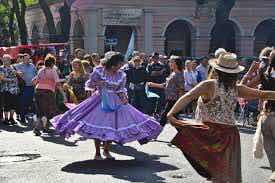
Before we reach the main square, we can hear the music. The feria is a folk event, so the tunes are those of chacarera, chamame, chamarrita, zamba. The dancers are already in the square. We spot our favourites from our previous visit. Aged a little, the crevices on their faces deeper, perhaps their stepping slightly slower, remarkably they acknowledge our arrival with a smile and wave. 


They are dressed in traditional costume, the men with deep-pleated pantalones held up with a cinturon de gaucho, the wide leather belt, frequently decorated with coins; the women in ankle length dresses with swishing petticoats. 


Here too is a new generation of dancers. Folklorique, once unfashionable with the young, is developing a new status, returning into the schools and providing a gateway to dance performance. 

The sun is hot, and before dancing, we call at Antigua Casa Galli at Lisandro de la Torre 2413, a store de ropa de trabajo and talabarterias so traditional that it has neither email nor web presence, reminding me of Charles Batten milliners in Soho London where in the 1970’s I worked as a student. With help from the proprietor and his elderly mother I select a traditional sombrero to team with my Aux Charpentiers bombachas. 

Three chacareras in the midday sun are quite enough for Stephanie and me, so we make our way to the adjacent asado where the Asadore directs his assistants away and leaves his coals to serve us himself. Glancing at my new sombrero and old bombachas, he declares that, for a gentleman gaucho, my copa de vino is free without charge and shall be served in his personal copa bronze, rather than a plastic cup. 


The lomito beef is so tender and succulent that our asadore’s knife slips through effortlessly. Sitting in the shade of huge Jacaranda trees, with a spoonful of chimichurri and copa de vino our meal is perfect.

We listen to the folklorique bands, then stroll the return journey via Av Lisandro de la Torre towards Directorio, dropping down to the junction with Murguiondo for the diverted linea 126. Taking the off-side back seat as is our custom, we sink into silence, perhaps due to the generous copa de vino, or simply having danced in the sun, whilst holding hands and reflecting on the joys of our day at the feria.


13 Fronteras


What do you do with flyers that come through the letterbox? Normally, they are irrelevant to life and go in the bin.

But there was something about this flyer that stopped us in our tracks. It was not that the chef was from Washington DC (wherever that may be). But inspirational plates with novel ingredients? Could this be possible here in San Telmo? And so close by - right next to Origen, our favourite walking-distance cafe for breakfast.

When you go out for a meal somewhere new, you take a chance. We had walked by earlier glimpsing through the windows to a spotless kitchen and sharp interior. “Yes, let’s give it a go, and let’s see what David Soady the chef can serve up that will excite us”.

Going straight to the point, this proved to be the most interesting and exciting meal of any we have eaten in Buenos Aires: a masterpiece of composition, flavour, interest and appeal.


As fairly discerning ‘foodies’ Stephanie and I like to arrive early, before the rush and crush - generally the ingredients are fresh at opening, as is the cook. And so it was shortly after 7 pm that we walked into 13 Fronteras, to be greeted by Senor Soady. Here the kitchen, and the magic that happens in it, is an open part of the deal. You get to see the preparation and cooking of precisely what you are going to eat. And you get to chat with David, chef, owner and inspirer of 13 Fronteras. 

With few other customers so early, we were able to monopolise David’s time - and using my lawyer’s skill and Stephanie’s guile, to interrogate him about his restaurant. We could now describe how the restaurant was inspired, and tell about David’s history since he left Washington DC and arrived two years ago (via El Salvador) in Buenos Aires. We gleaned that he had worked at Aramburu, one of South America’s best restaurants here in the city before opening 13 Fronteras in San Telmo on 10 December 2017.

But we would rather tell you about the food.

The menu at 13 Fronteras is quite simple. Gone is the impossible multiple choice of dozens of dishes. Here you have a choice of 13 mains. For alcoholic drinks, there is beer or red wine - making our selection of La Puerta Malbec from Famatina a simple and delightful task.

After much deliberation, Stephanie chose la churnea, a white fish caught of the coast of Buenos Aires Province, served boneless, together with chunos and toasted maiz mote. The dish, pictured here on the first plate, was utterly fascinating in flavour and composition. This was fine dining at a totally accessible price point. 

Pictured on the second plate, I selected porchetta, delicious succulent pork, cooked whole, then portioned and served at the prime moment, so prepared to tender perfection. 

We had opted for a pavement table nestling beneath a Jacaranda. As dusk fell, David returned to introduce us to the desert menu. By now, having understood the potential magic of 13 Fronteras, we simply left it to our chef to make our choice. David returned with coca panna cotta with hibiscus for Stephanie, and for me a desert with a surprising range of ingredients, including those that could never be guessed. “If you tell me what is in them, you may eat here for free for the rest of your lives”, David jested. Stephanie and I agonised for 10 seconds, before simply succumbing to the deserts and giving up on the task. The combination was perfection - like Argentine tango, the panna cotta being light as an upper body giro, the mystery desert being rich, vernacular and grounded.

What I have not managed to capture here was the fun of the meal, with its additions and San Salvador tones, courtesy of Cristabel, David’s San Salavadorian wife. Having David almost to ourselves was a bonus, but the conversation, guessing and tasting provided a special experience.

13 Fronteras is now number 1 on our list of Buenos Aires delights. When you arrive in the city, ensure that your first visit is early, for you will surely want to return. 


Salon Canning and Orquesta Romantica Milonguera


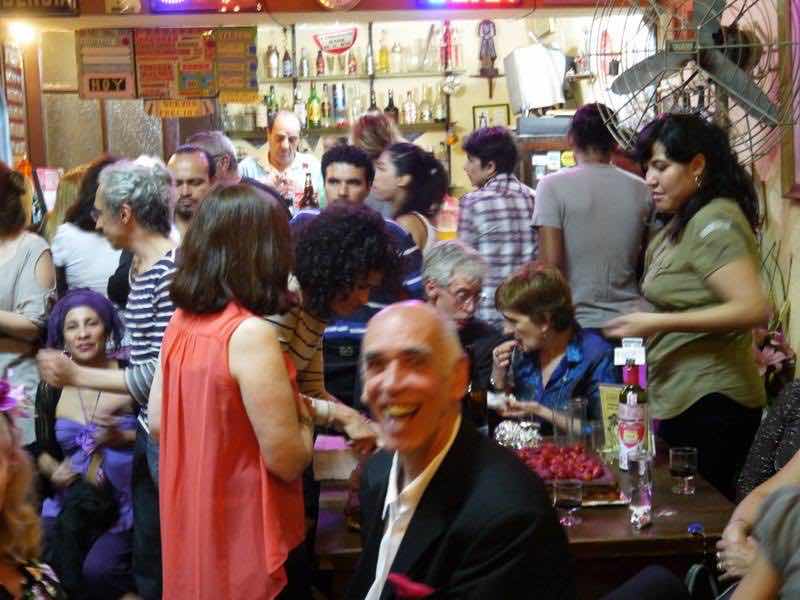
There are fringe milongas; and there are posh ones. Salon Canning (or just Canning to its regulars) is definitely one of the posh ones.

Canning is less favoured by this vernacular tanguero; yet there are times when it is fun to dress up, hail a cab, arrive in style and dance until the early hours with the glitterati, the polished Canning crowd. Tonight is one of those nights.

It's 11pm when our dance professor insists that we join him for a night out at Canning. We are already dressed with our best dance shoes. The invitation is timely. Moreover, Orquesta Romantica Milonguera is to perform there at 1am, after which there will be two dance performances. Moments later we collect in 9 de Julio, flag down two cabs, and race towards Av Cordoba and the journey to Scalabrini Ortiz. 

Canning is one of those iconic milongas that seems to have been there, always. Its history is a little cloaked - its name does not register in the list of famous milongas of the Golden Age - but every self-respecting tanguero (and those that aren’t) ensure that they dance at Canning. 

Spilling from the taxi, we join a short queue to obtain our 150 pesos entrance ticket. Around us magnificent milongueros hug their friends, as well-heeled milongueras disappear into the banos to change into their dance shoes. On entering, the room is packed. It is hard to discern a single seat, let alone a free table, however Patrick has pre-booked the last remaining place in the corner of the salon. 

The Canning set inspect arrivals as they process to their tables. Milongueras in tight fitted dresses slashed to the thigh look disdainfully, whilst the old milongueros, busy with each other’s egos, hardly notice our arrival. If you are somebody in tango, Canning is a definitely place to be seen; a smart club of mixed age group that tolerates the spice of foreigners that flock to dance here.

Settled, with sparkling water, Stephanie accepts my cabeceo and we wind our way to the dance floor. Along the route we teeter between close packed tables with innumerable chairs. We angle our bodies and tip-toe through to the pista. The unending passage of tangueros breaks with a nod to invite our entry, and we are subsumed into the outside lane.

Late last year, Francesca reported the demise of Canning’s ceiling. During a sudden downpour, water and plaster rained onto the floor and tangueros scattered. Tonight, all is restored, with new lighting and bright white walls to replace the yellowing paint. At the head of the room is the iconic mural, a photo-montage depicting the Canning notables. Elsewhere, bright coloured pictures grace high walls above the sea of tables. 

Busy Friday nights at Canning test the art to deliver a joyful dance for one’s partner. The floor is so tightly packed that movement is confined to immediate personal space, and even this is under constant threat from those behind or in an adjacent lane of dance.

The first song over, we have advanced four metres. Ochos, ocho cortados, and giros become the staple diet of the Canning floor. Walking, which was the mainstay of Golden Age tango, is almost impossible. Our tango world has shrunk to a micro world where every movement is condensed, shortened and tightened. I intercept my giro as I sense the closeness of the dancers behind. 

It is now evident why tonight Canning is so densely populated, for we pass an area, usually filled by tables, that has been cleared for the orchestra. Pink blouses and black suits identify the performers who have gathered to one side for photographs. Orquesta Romantica Milonguera is currently the darling of the milongas, having taken Buenos Aires by storm in 2017.


Sometime after 1.30 am the orchestra performs, and the floor floods with tangueros and others. Buscandote, Oigo tu voz, Solamente Ella ring out like bells across the floor. Tomas Regolo leads from the piano, Roberta Meagli, nursing her bandoneon, looks up and smiles; Roberto Minondi and Marisol Martinez arrive simultaneously at the microphone to sing. 


Whilst Orquesta Romantica Milonguera’s sound is distinctive, it is Marisol that seduces the audience. As in the Golden Age, where the vocalist would not appear until half-way through the song - it is said, because to do otherwise would result in the women standing to look at the handsome singer - Marisol will often make a late appearance. When she appears, the floor before the orquestra congests with desire as both men and women watch longingly. 

Later, as two professional couples give back-to-back performances, we struggle to watch through the press of standing dancers. It is time to leave. With our dance shoes tucked away in dance bags we nod to Andreea, and step out together into warm night air. Somewhere distant, a clock chimes 3 am. A taxi pulls up and we board. Now racing along the calles and avenidas, slowing only for the storm drains, we head back to San Telmo. Andreea is humming Fueron tres anos; dawn light appears just above the horizon. We all picture Marisol and re-define our tango love.


Orquesta Romantica Milonguera
Lucas furno: Violin
Luli Christe: Violin
Sara Ryan: Violin
Oscar Yemah: Bandoneon
Ricardo Badaracco: Bandoneón
Roberta Maegli: Bandoneón
Juan Miguens: Contrabajo
Tomás Regolo: Piano

Marisol Martinez: Voz
Roberto Minondi: Voz


Sunday in San Telmo


‘Hielo, hielo’, is the call from Calle Defensa. I peer down from the terrace to spy the white-coated icecream vendor threading his way through a mist of colourful tourists. His box hangs from his shoulders on broad leather straps that were used by his father before him, and probably his grandfather. The sun is still hot, so his trade is brisk.

Either side of the street the traders have their stalls. Early, about 8 am, we heard a gentle clanking on the cobbles, telling that the market overseeers were busy setting out the metal frames and wooden benches that comprise the displays. The sound, hardly discernible, was  soothing rather than disturbing. By 10 am the scene had changed, with advancing pools of tourists seeping, then pouring into the street. From time to time they pause, only to pulse forward when an opening appears.

It is now after 4 pm and the lone Argentine singer that stood away from the sun in the shadows has given way to amplified sounds of a singer, guitar and drums in San Lorenzo. Judging by the waves of applause they are surrounded by a crowd of onlookers that they are unsuccessfully teaching to clap a rhythm. The crowd must be English. 

In fact the English presence here in San Telmo is sparce, new visitors preferring the seemingly safer barrios of Palermo and Recoleta. English accents from around the world are however ubiquitous. It is the principal language for stall traders with those not bearing the tell-tale Latin signs.

Shortly, our performers will be expelled from the street by the San Telmo drummers, a band of about thirty who, as dusk gathers, process along Defensa every Sunday when not raining. They dress for carnival, with aerobic extravagance as they turn and spin.

Of course, Stephanie and I pass them at a pace. Our destination is not their rehearsal carnival, but the real street milonga in Plaza Dorrego. Here we will dance tango on the polished tiles of the square for an hour or so until Pedro (El Indio) Benavente calls the Santiago del Estero folk dance of Chacarera,  now learned by all Argentine children. 

At this point, we too slip away, along deserted Sunday night streets, and back to the lights of Independencia and home.

International Tango Day


It is Monday 11 December, and you will immediately realise the significance - it is ‘International Tango Day’ here in Argentina and across the tango world.


Why 11 December? Well it is, of course, the birthday of Carlos Gardel, who had he survived an airplane crash in 1935, aged then 44, would have been 127 years old today. Julio De Caro, tango composer and band leader, was also born on this day in 1899. Luckier in life and death than Gardel, Caro remarried aged 60 and died at the age of 80.

For tango dancers, their legacy is about equal. Without Gardel the singer and movie actor, we may not know tango today. It was Gardel that breathed romance into the music and gave it immortality. In 1928, his sales of 70,000 records in Paris in the first 3 months of his visit, paved the way for his films ‘Cuesta abajo’ and ‘El dia que me quieras’ six years later. Through them and him tango reached an international audience of film-goers and music lovers, where it has remained since.


Isabel del Valle


 Carlos Gardel’s widowed mother, to whom he was devoted  


Romance came at a cost for Gardel. His long-term ‘lover’ Isabel (pictured with him above) was kept secret to preserve his eligibility as a heart-throb. Carlos’ actual sexuality however remained slightly opaque. Later in life he and Isabel separated: she found the love she craved; he remained single to his death.

Julio de Caro was a colossus amongst band leaders, and dancers throughout the world count him as one of their favourites. Without Caro, Argentine tango music would have lost a critical peg that changed and matured the music through the 1920’s and 30’s, and made it accessible to high society.

I am the grandchild of Caro (and maybe Gardel). You, my dear reader possibly the great-grandchild. As such, we remember both this day, and this dance. Later, as the temperature drops at dusk, the streets of San Telmo - and other barios throughout the city - will fill with tangueros. There will be music and embrace. Argentine tango, cherished daily, will receive its annual and deserved celebration.


San Telmo Diary - the first weekend


8.30 am and sun streams through the open window onto a table covered with a white lace tablecloth and bearing Francesca’s cream teapot full of fresh tea. Someone sings below, birds chirp from the roof rails, eight parakeets squark as they fly past in formation, in the distance lorries grind away from the lights on Av Independencia.


A Saturday city. Weekends in Buenos Aires slow down from the weekday race. They have an altogether different pace. Waiters at the little cafes on Calle Defensa no longer rush from table to table, but stroll in the sunshine. The air is lighter, softer, crisper, as is our weekend mood.


This year I have brought binoculars with which I scan rooftops from the terrace. To the north maroon-red brickwork marks a monastery. Beyond, the distant towers of Puerto Madero pepper the skyline towards Retiro. East, the view is towards the classical colonnades of the university engineering faculty building. All around are roofs and terraces, some with palms, others with plant pots. Half a kilometer away an elderly woman retrieves a towel from the roof line. Four cats laze on a remote ledge. Windows glitter as morning shutters are opened. 


One tiny, white, passing cloud blows past on a light breeze. As it moves, it dissipates into the morning’s warmer air. It is time for breakfast. “Let’s head for Origen?”, suggests Stephanie. “What a good idea”, I rejoin as we head for the stairs.


San Telmo Diary


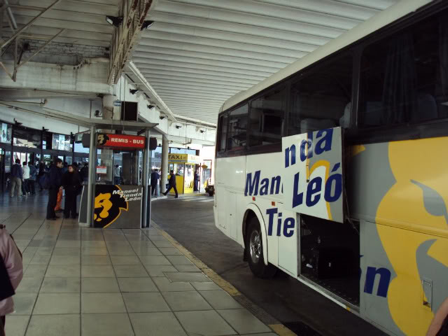
He looks over his glasses and directs a thumb to a screen. Fingermarks register our return visit. He smiles. Without words his eyes say ‘Welcome to Argentina’. Through the ‘nothing to declare’ channel, from the kiosk we buy a Manuel Tienda Leon coach ride from Ezeiza to Buenos Aires, and walk towards the electric doors. 

I look at Stephanie and our eyes meet. We had pictured this moment as one we would recognise: the point of transition between two worlds: leaving Europe and returning to Latin America.

There is something about the moment that is singular. Flight side is busy in a workmanlike way. It is a last refuge, where you may check your luggage, retrieve a purse of pesos or find an address. The doors slide and we pass through to the city side - a new, vibrant, pulsating Latin world of humanity. Tiers of drivers hold placards, some hastily drawn in felt-tip, others boldly announcing corporations; porters rush around with trolleys and cases; families holding flasks of mate are meeting and hugging; police stand in small clusters; voices call; a shrill whistle blows and a surge of taxis and coaches jockey for position on the grid.

Outside the terminal its hot, yet fresh. A light breeze stirs tall palms and blows fallen blooms of purple Jacaranda across the paving. We have arrived.


All vehicles arriving at Ezeiza at some stage must leave. Like other airports around the world, it is after all just a point of transition, its currency being ‘the journey’. But whilst arrival here is simple and seamless, departure is typically Argentine. 

Our coach bustles onto the exit lane. Already horns are sounding, the coach driver shouts at a taxi. Vehicles rush for the exit, each space a small war-zone. Our bulk and the telling dents to the rear off-side carry the day as queues of small cars and taxis snarl behind us. Now the breeze ruffles stretched curtains at the windows and there is a rhythmical chink from the limp workings of the speed limiter as it hangs uselessly against the bulkhead.

On the autopista and through two sets of tolls, we are now heading into the city. Alongside is our strangely familiar Buenos Aires, a city in constant flux with half-built blocks and roofs covered with water tanks and satellite discs. From the raised sections of the carriageway the city stretches interminably, dense, sprawling and compact. Millions of lives are buzzing like small electrical currents and with them, the hustle of city life. We descend from the elevated Autopista 25 de Mayo, turn east in Avenida San Juan onto Paseo Colon. Working our way through the crisis bus-lane road works, we arrive at Retiro. The coach squeezes into the narrow dog's-leg entrance to Manuel Tienda Leon coach stop where we transfer to a little grey taxi, and start our return journey to San Telmo. 


Parque Lezama - the bright side of life and the inevitable destiny


“Where shall we go this afternoon”, said Stephanie, adding quickly, “don’t forget its pizza tonight”. “How about Parque Lezama?” “What a good idea” I rejoin, thinking already of pizza and chilled Lopez.

And so it is to Parque Lezama that we walk, taking the scenic route via Balcarce, Cafe Pride and Cafe Rivas.

An undisclosed, but significant sum of pesos has been invested in Parque Lezama since 2015, turning a tired provincial park into a wonderful work of horticultural art. Sculptures were removed and replaced in polished condition. The children’s play area was relocated from the centre of the park to a convenient (and discrete) lower level. Huge palms were copiced, and have regenerated with succulent growth and a fresh crop of fruit to feed the resident parakeets. Altogether, magnificent.

Today is the day to visit a park. It is 24 degrees, with a light breeze. Overhead there is not a cloud to clutter a 210 degree azure sky, halfway between blue and cyan. The sun shines.

We enter by the amphitheater at Av Brazil on the north side. A lone workman scrubs graffiti from the wall. Perhaps this is his ‘community service’? We mount the steps leading into the main park. To our left the ancients sit at stone tables to play chess and draughts. Ahead white poodles are walked by their owners beneath trees crowned with candy coloured blossom.


We follow an anti clockwise route on the new brick paving, taking in the restored balustrades and enjoying open views. Small plaques to our left indicate the species of tree; ahead - a colonnade set with new benches. Riding slowly on their black bicycles, two policemen pass-by, nodding with appreciation as we give way to their progress. 


Stephanie and I select a bench that still enjoys the afternoon sun, to watch park life. To our right a tai chi figure unfurls a cerise banner, two lovers pass pausing for a long kiss, at one side a group of college students sit together with books spread out on the grass beneath the canopy of a tree. Here is the hum of humanity, gentle, almost gentile. In the distance, the bark of a lone dog, and the sound of a car horn. Then a sudden breath of a breeze lifts Stephanie’s hair and ruffles my collar. This solitary wind is different from others - it signals an altered energy on which the pea-green parakeets have taken flight.

After a while we rise to continue our walk in the park. Just around the corner we see the same two black bicycles stood together on their stands joined by a checkered tape. Two dark figures bend over a pile of clothing on a sunlit bench. One of them reaches down to lift an arm. From the end of the bench dangle two legs with feet clad in old boots. A policeman, with remarkable sensitivity, removes a watch from the wrist, and places it in a tiny pile with other possessions. A blanket covers all but a shock of grey hair. There is no sound; no movement; nor has there been since its discovery. The ‘solitary wind’ now makes sense. That stillness spoke of a moment passing.

Now, children dressed like miniature shopkeepers in long white coats return from school in small groups or with admiring parents. The park springs back into life as the volume switch turns. Contemplative, we walk, hand in hand,  regarding our lives with a fresh value.

“When I die, I want it to be like that”, I say, “On a park bench here in Parque Lezama, in the sunshine, my spirit borne by a flight of green parakeets”, I add. Stephanie smiles. “We will see what we can do”, she says quietly, with a twinkle in her eye.