Showing posts with label milonga. Show all posts

Maldita Milonga with Lucia y Gerry


It is Wednesday night. For those living in, or visiting San Telmo, this is the night for Maldita Milonga at Peru 571. 

Dressed casually, Moneypenny arrives promptly at 2230 hrs. Today temperatures have reached the mid 30’s and it is still warm from a day of uninterrupted sunshine. Helpfully, a Buenos Aires breeze whips lazy pools of daytime air and spins them into the darkness.

Stephanie and I join Moneypenny on the stairs to descend to Defensa, and then to wind our way through the San Telmo streets, passing cafés, restaurants and bars to which the early night revellers have repaired. There is a softness about the evening. San Telmo is unhurried. Few cars pass, here a taxi sails by looking for a fare, now colectivo 24, then a lone cartonero pushing his trolley of boxes. We walk in silence, soaking up the evening, from an open doorway hearing the sound of jazz, voices laughing, glasses chinking. A jacaranda tree, now almost devoid of purple flowers, is in full leaf swaying gently to what appears to be the same tune.

Maldita Milonga is one of those ‘must-do’s for visitors to Buenos Aires. It is a milonga with a difference: that difference being El Afronte - a very different tango orchestra. Those of my regular readers will recall my blog from November 2015 in which I recorded Sara’s last tanda in Buenos Aires. It was here at Maldita that Sara experienced the full energy of a tango band for the first, and the last time. Her final Facebook post read, “We sat directly in front of four passionate, highly energetic and totally absorbed bandoneon players. I felt as if my whole body was electrified, especially when they played their final Pugliese track, La Yumba! The effects of the powerful live music felt indescribably healing”.


Tonight we are meeting with friends at Maldita. Friendship is a privilege, and few come more handsomely than Lucia and Gerry  They are arguably Buenos Aires’s most authentic tango teachers and delightful people. As tango’s Golden Age came to an end, tango was forced into concealed recesses of ‘underground’ milongas by governments that feared public meetings of any kind. The famous milonguero Oscar Casas managed to collect the reminiscences of old milongueros (teenagers in the late 1940’s and 1950’s), and his set of lunch-time video recordings captured their stories about tango. 

If you go to 6.15 in the Almuerzo Milonguero Part 4 video you will hear reference to ‘La Flaca Lucia’. This is Lucia Seva - who became their very favorite milonguera. Alito says, “She lives and feels the moment” Neli replies, “Yes, that is a milonguera!” What better reason could there be to learn from the only living link that carries the traditions between then and now? 

These days, whilst coaching more experienced tangueros in the ‘milonguero style’, Lucia and Gerry also successfully steer non-dancers and new tangueros on their tango journey to tango competence. As part of the experience, they escort their students to a variety of authentic milongas, of which Maldita is one. 

We join Lucia y Gerry and their students at the table marked ‘Reservado Lucia’ - which is all that is needed in San Telmo. Some students have come straight from their tango lessons in Balcarce. New dancers will be taken to the centre of the pista to get their first feel of a milonga; the more experienced tangueros will be introduced to some of the lesser-known codigos. 

I receive a hug from Gerry, who I first met in 2007 on my extended visit to Buenos Aires. He has an encyclopedic knowledge of the tango orchestras, and one of the larger collections of popular and obscure tangos. Chatting to Gerry takes one back to the 1920’s to1940’s - the golden era of tango music, when orchestras toured the regular salons in the city, and milongueros only ever danced to live music.


Shortly, Gerry and Lucia take to the floor surrounded by coloured marker lights. From a dark corner, Gerry checks with a following tanguero, and receiving a nod of approval to enter the pista. Theirs is not the stage-effect tango of performances; it is keyed to the floor, in close embrace, totally connected and seamless. No show is necessary. The joy of watching is to see tango as it was always danced - and within the milonga, always should be. Within moments, they slip from view. We crane our necks to catch further glimpses, but they have gone, swallowed up by a turning tanda. 

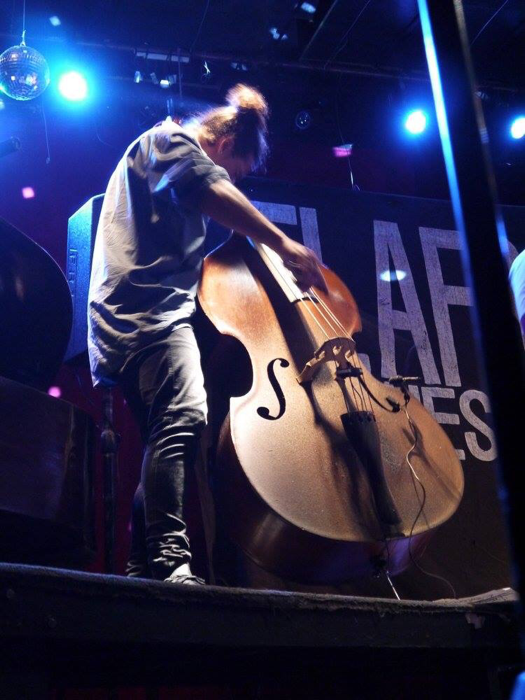
It is now 11pm and movement on the stage behind us foretells the arrival of the orchestra. A tanda finishes; suddenly there is darkness. I count the seconds, then the crash. Lights burst into a host of colours - bright intense, and sallow dark. The shadows are ripped away and there is the orchestra - tonight eight performers, fronted by two bandoneons, with three violins/violas, cello, double bass and piano. Within four more seconds the singer Marco appears. He has sung with the orchestra for over a decade and is an integral part of their sound. 

El Afronte are not for the faint-hearted. Their sound is magnificently aggressive. Each instrument takes its share of percussion, so that their songs pulse with primeval energy. We feel the reverberation through the floor and it rises almost to the chest. Anything that will resonate does so. The bandoneons grind their way, and violins chase to catch up. At the end of the first song dancers take to the floor. Theirs is a different tango - one that expresses angst, sorrow, joy and decision. 


With an emphasis on Pugliese style, this orchestra is not the easiest to mark. Inexperienced dancers find themselves beached during changes of rhythm - or those moments when the music moves from bright-light to dark-obscure. Tango music has always had this quality, but El Afronte magnify the contrast to a point that requires total dance-absorption-awareness. Those that dance well to the performance are those experienced in the dramatic art of tango; accompanied by those who cannot spell the word ‘disinhibition’.  

Stephanie and I watch; but no El Afronte performance would be complete without dancing a tango. We select a quieter song that offers less drama and feel our way out onto the pista. At this moment we sense that we have truly arrived in Buenos Aires. Laura, Maldita’s organiser smiles from the shadows. We hold in close embrace. Stephanie’s Katrinski flats caress the floor. And I breathe in the moment.

We will stay until almost the last tanda played by the DJ following El Afronte’s departure. It is now 2.0 am. We reach the bottom of the staircase and the streets of San Telmo are deserted. Distant is the sound of a siren, wailing on limpid air. I link arms with Stephanie and Moneypenny as we walk the length of Peru towards Independencia and home. 

With thanks to Lucia Seva for the photos

Plaza Dorrego - the final tanda


In a trip to Buenos Aires, you should at least once dance in Plaza Dorrego.

Here in the heart of San Telmo is the most iconic square, where on Sunday nights locals and tourists dance tango under the stars. Pedro ‘El Indio’ Benavente organises the milonga, providing sound system, lighting and a demonstration, and it runs from 7 - 11 pm in the summer months. It is part of what makes San Telmo the tango barrio.

Stephanie and I arrange to meet Miss Moneypenny and TT there after 8 pm. “We will be sitting on the little wall where you change your shoes, or dancing” adds Stephanie; and indeed we are dancing when they arrive from their different barrios. 

With our street shoes tucked inside our bags, and the bags placed securely in the pile next to where Pedro masterminds his playlist, Stephanie and I have squeezed onto the floor for a tanda of Calo. We join dancers of all ages and abilities. Our attention is drawn to a young and energetic couple as they ladle their DNI moves across the polished tiles. Then our discerning eye fixes on a mature couple in their 70’s who dance in close embrace. He gives a clear but sensitive lead, and despite her elderly thickened calfs, she collects her heels perfectly and dances like a dream. They are the prize of the pista. 

We dance a circuit of the floor just before the tanda finishes. For Stephanie, this is like tasting a shard of chocolate from a whole bar, and she wants more. So despite the next tanda being ‘milonga’ - a quicker form of dance - we return starting sedately with Canaro’s Milonga Sentimental. 

I do my best with my new found milonga skills following Patrick Arellano’s instruction, and these are just good enough for the first three tunes of the tanda. A fourth song is fast and the floor has become crowded, so at my request, Stephanie and I step from the pista to resume our places on the wall to watch.

As the final song progresses there is a moment of consternation. Dancers group to one side of the pista. From our position it is impossible to see what transpires. Shortly, we are aware of figures rushing from the southern end of the plaza. The music falters, then stops. Circling dancers stand in couples; and couples in silent groups. They look from side to side questioningly. The non-dancers that crowd and watch from the perimeter of the pista break the moment with animated questions and comments.

Gradually, the pista clears. Tangueros are returning to their places at the edge of the square. A hush descends.

The joy of tango is not simply the mastery of an intricate and difficult dance. It is about a journey within an embrace. Often we hold - or are held by strangers in an intimate embrace, that speaks of a primeval need to be loved, to belong, or at least acknowledged as we go through life.

Tango is a hard journey, through testing times before reaching the goal of fluidity and true connection. For this reason, the skills of young, quick dancers are not the ones that we covet. They are yet to qualify for milonguero status. The older, experienced dancers often hold the key to tango. They take time, in silence they listen to each other and the music, they connect, and they accommodate the moment. And so it is here in Plaza Dorrego. Life, love, anxiety, and intimacy are played out each Sunday as dancers travel to their chosen destination in their own personal tango journey.

Four figures are now kneeling on the ground in concentric focus. There is movement, but little activity. A circle of watchers gathers. Something is amiss. Don Bernabe, the grandfather of this little milonga, speaks quietly with Pedro. He in turn moves forward, but to stop. We hear the sound of a siren as it draws closer on the night air.

The figure on the ground is that of a tanguero of senior age. His polished tango shoes glint in the evening light as he lays. 

Time suffuses and the evening gathers in a surreal envelope. Dancers wait in the shadows, patiently, and expectantly. The expectation is that the figure will rise from the floor. Perhaps he will be helped to a seated position, be assisted to the wall where someone will produce a bottle of water for a much needed drink.

But that expectation is not to be. The figure does not rise, nor now can anyone assist him on this final journey. Even the crowd of tango watchers falls silent. On the far side of the plaza in Defensa, the drumming of the carnival drummers ceases. Plaza Dorrego has never witnessed such silence. People huddle together and whisper. Faces that were intent on dance now look drawn with sadness. A frailty is cast across this place. It is the frailty of life itself. It is - at the end of the final furlong - the end of a journey.

Miss Moneypenny brushes a tear from her eye, and TT places a motherly arm around her shoulder. I pull a shoe lace and reach for my street shoes. Stephanie gathers her bag and folds a wrap close around her. Without words, we walk. I pass Don Bernabe to give him a hug. “This is how life is”, says Pedro Benavente philosophically and without drama.

Back in Defensa we climb four flights of stairs to our rooftop apartment. Moneypenny and TT join us for they sense this moment should be shared, rather than ignored. With a bottle of wine to ease the weight, we sit in the half light and speak of tango, and of mortality.

His was a tango journey that ended as tango journeys should end. Whilst the aftermath is of unimaginable grief, the moment was that of a tango dancer on a tango floor within a close embrace. Together we clink our glasses and wish him 'Godspeed'.


Casa Luna and Los Consagrados

Casa Luna is situated in the bario Monserrat, to the west of the micro centre, just a few blocks over 9 de Julio.  Monserrat is an old, and historically poor bario, the resident population being families that have lived and worked here for generations. The street is busy teaming with life from early morning ....to early morning.

We occupy the ground floor Eva Peron room, but by choice will move to the upstairs Carlos Gardel room after our hosts Vicki and Rob leave for the USA. The Gardel room has ensuite bathroom and small sitting area, with easy access to the office. A back staircase leads to the single Porteno room. Exit through the garden door and you reach the Garden apartment, connected to, but separate from the main house. Double sliding doors ensure lots of light, whilst the garden setting provides total peace. It is at the large table in the garden here that I sit and write. A breeze rattles the leaves of the banana tree whilst red geraniums and hydrangeas add splashes of colour to dense green foliage that reaches over twenty feet above my head.

In the bario just paces away fresh fruit abounds at the corner shop, whilst diagonally across is El Gigon, a superb perilla serving the most divine steaks. On the other corner a pizza shop, and but two blocks to Campo dei Fiori where outstanding fresh pasta is served under the ancient domed brick ceilings by equally ancient waiters who started here as boys.

But now for tango. Saturday night is the night of Los Consagrados.

Buenos Aires is a city of milongas - the location where tango dances are held. Of the more traditional is Los Consagrados in Humberto Primo 1462. Those assiduous readers of my blog will recall my blog entry from 2010 in which I described an exhibition here of tango from Lucia y Gerry

We depart in limpid air as dusk arrives. The entrance way is grand, with metres of marble leading to a majestic staircase. Above the romantic notes of Lucia Demare are muffled by heavy curtains, beyond which the salon extends longways through a mirrored hall. Tables are filling, but we are booked as Vicki and Rob's guests, so separate according to convention to sit at reserved tables opposite across the room.

As a new tanda starts, prospective dancers search across the room for the cabeceo and mirada - the code  to identify a partner. Stephanie accepts my cabeceo for the first dance, and I cross to her table. She rises. We enter the pista. It is Calo, a deliciously expressive tango. As new dancers on the floor we attract inspection. Seated dancers assess the level of our skills and experience to determine whether they too will accept our cabeceo and mirada in forthcoming tandas.

Whether as guests of Vicki and Rob - veterans of Los Consagrados- or because we have just passed the test of initial inspection, we dance most tandas for the next two hours. It is clear that 'the embrace' is key. Get it right, and tango is effortless. Get it wrong - the dance is tough like stringy steak. Here the Portenos - local dancers - are unforgiving. The embrace must be close, gentle but safe, flexible but clear, sensitive, intimate but respectful. It is the door to connection. And with connection comes the perfect tanda.

Satiated with tango for one night, and fresh to Buenos Aires, we leave to eat; our destination being a loved pizza cafe in San Telmo where we will be greeted with hugs. Outside the milonga, the bario shines and gulps of warm air from an evening breeze refresh our faces. We slip our dance shoes across our shoulders and stroll hand in hand. Yes, we have arrived in Buenos Aires.

The story of Voodoo Café


Voodoo Café Milonga Club arises from the story of Tango a Trois and Café Banlieue.

One July, three musicians met by chance in Café Banlieue. Peter Ludwig, pianist, was playing tango in the café bar, whilst celist Peter Wopke and violinist Arben Spanhiu, both professional musicians in the Bavarian State Orchestra, stood at the bar and listened with wrapped attention. What they heard, they loved. Tentatively they took out their precious violin and cello and improvised. The music they played was tango.

After that night, each week the three met at Café Banlieue to play together when the café closed to customers. Some regulars asked to stay behind, sitting in the darkened shadows to listen. One, Nellie, started to dance. Thus Tango a Trois and Café Banlieue ascended into tango folklore - and our concept of the Voodoo Café Milonga Club was born from it's memory.

At Voodoo Café we have a small floor, contained but not surrounded by tables. For us, the floor is a resource rather than a focus. We dance, and encourage those who have never before danced - to try tango. Leaders are invited to forget their feet, and to concentrate on leading their partner through a soft embrace. This is how we learn dissociation - leading by the torso, allowing our feet to follow where we have led. First 'steps' are not steps at all, but leads. New followers simply to walk with the lead and beat, advancing to the giro (a turn), and the keystone - the ocho.

Part of our concept is to introduce people to Argentine tango without having to go through the too challenging process that can come with learning it. Those with established skills tend to be insecure when trying something new. For many men, dancing can be daunting - but dancing tango is beyond belief. So our focus is on the value of the embrace and the way it works to create direction and 'feeling' in tango.

Prominent is the importance of embrace and connection. Leaders are taught to 'invite' a change of direction or pace. The style owes more to Juan Carlos Copes and his daughter Johana than to a more modern and technical style. By learning this way we develop an affinity with Argentine tango, a dance where 'attitude' and 'feeling' is more important than 'steps'.

Of course, some come not to dance, but to watch, or simply listen to tango music. Here we capture the essence of the Buenos Aires milongas which accommodate everyone of every age, interest and ability.

On Thursday night, as the softening summer night closed in around Voodoo Café windows, I looked around the room. Lights were dimmed, and small candles flickered on the tables. Tangueras draped themselves across high stools, and tangueros cabeceod across the room to secure the next tanda of dances. I had an overwhelming thought - this was the moment of which memories are made - a snapshot in time to a feeling of pleasure, friendship - and tango.


Voodoo Milonga Club


In April 2012 a small group of visionaries met at the Cantina Voodoo Cafe, Darlington. Among them were the cafe proprietors, Les and Kendra, and the tango dancers, Stephen and Stephanie supported by their tanguero friends who just love to dance.

This was the moment that gave birth to a new tradition: the Voodoo Milonga Club. The idea was to create a new milonga experience in Darlington. For inspiration, we gazed back to the 1920's in Buenos Aires, when the early immigrants to Argentina who danced on the stone flags of La Boca, first got together to hire a room. This was what we would do - a meeting place where everyone could sit, relax, eat, drink, dance, watch, meet, chat and chill. Yes, those who wanted to dance could get up and dance or take the early faltering steps that eventually fascinate and ensnare the would-be dancer in tango. And those who simply want to watch, or listen to the intricate, delicious music from the Golden Age of tango, could do just that.

With our dance shoes strapped across our shoulders, Stephanie and I walked the historic gates of Darlington - through Houndgate, across Blackwellgate into Skinnergate where, at number 84, the Voodoo Cafe announced its presence with the faint sound of tango. The tables had been pulled to the sides of the room and the warm glow of the bar cast intimate shadows into quiet corners. The scene was authentic 1930's Buenos Aires.

Dancers and watchers arrived, to be met with smiles and hugs. A tradition of Buenos Aires is the greeting - the most important part of genuine connection between two people. In Argentina, the hug is ubiquitous, and so forms part of the Voodoo Milonga experience. Colin and Joan, Catherine and Phyllis, Geoff and Corinne, Jayne, Morgan and Kat, Greg and Sarah were the early arrivals, taking to the floor, or simply chatting and watching. Voices of English, Spanish, Haitian Creole and French curled like smoke amongst the tango music of Rodriguez, Donato, Canaro, Biagi and Verela. Shards of light were created by the contemporary tango of Otras Aires, Bajo Fondo and Gotan Project.

So, what of the future? Our tango dream has taken form. The Thursday haven of beautiful tango music and dance is now a new reality. A place where friends meet, enjoy an embrace, share a glass of Malbec or Champagne, taste the flavours of burritos, chimichanga, feijoadas and fajitas. An oasis of Latin culture in the sea of turbulent English life.

If you dance, perform, sing, play or simply love to soak up the atmosphere of something new and entirely different, join us at the Voodoo Milonga Cafe. It will probably change your life.