

30 Apr 2007
Today I have been to Puerto de Olivios to the north of the city. My invitation came from Julia, Miguel, Carlos and Ednia. The venue was a country park on the banks of la Plata, looking out across the Rio towards Montevideo and Uruguay. This particular park is owned by the Argentine military authority for their personnel. Carlos is an employment lawyer, but as the son of a former military ruler, has life membership. It is beautifully appointed with BBQ areas and tables spead across the lawns towards the river, a total contrast to the hustle of Buenos Aires. We set off from Retiro station, the Victorian edifice that is part of what remains of the original English railway system. The train was ancient and cramped taking local people to visit relatives outside the city or to escape for the day. It drags noisily across old tracks, hardly exceeding 25 miles per hour, with cars passing ahead on the adjacent roads. Between the tracks are sheds covered with tin or tarpaulins, reminiscent of South Africa, occupied by the homeless as one way to escape shop doorways of the city. It is only embarking on this journey that the reality of 6 million people living in greater Buenos Aires dawns. No longer protected by the city centre, the visitor is exposed to another side of Argentina, where streets and apartments go on through bario or neighbourhood onto the next district, some like Belgrano, expensive with wonderful tennis courts and the President's home, and others down at heel save for the verdant vegetation which lines streets and railway sidings. In all are the old colonial homes, often dilapidated as if left back from a bygone era as the only remnants of Argentina's prosperous past.
Asado in Buenos Aires is something to behold. The grill has to be at least four feet in length to accommodate the mountain of steaks which form the backbone of dining outside. Clouds of smoke arose from dozens of charcoal fires as the Argentine men, expert in the task, prepared the meat. The women prepare everything else. We sat as a family, ate, drank local wine and chatted as the afternoon sun sank across the Rio de la Plata, at one stage the rippling waves appearing like sparkling orange peel with evening light. Fleets of little yachts bobbed out in the Rio, and flocks of green parrots flew noisily to their roosts where they would rock in the trees as they climbed the flexing branches.
Julia Miguel and I travelled back on the train, recognising some of the families who had been on the outward journey. This time the train crawled back through the dark towards Retiro as if struggling under the strain of its occupants. I was informed that the train was in fact quite empty compared with weekdays.
Once back to the city we retired to the bookshop in Palermo. Now later Sunday evening and filled with readers who would occasionally rise for coffee or a soft drink, a cake or biscuit and return to their book. Yes, people did buy books, but this seems secondary to the process of relaxing and reading, or in some cases, snoozing with a book in the lap. An unhurried end to a successful, gentle and informative day.
Subscribe To Stephen Tango

 Posts
All Comments


dancing tango
19 Apr 2007
First, my apologies to Jayne for cutting and pasting part of my reply to her. But when I re-read it I felt that I should capture some of what I had said in the blog!
What I am finding here in Buenos Aires is that the dancing we experience in England is nothing like how it happens here. Tango is all to do with connection between a man and a woman. The dance for a woman is like being rocked in a loving embrace. It is seriously intense. The women always dance with their eyes closed and the milongeiros transport them to a state of ecstasy in the course of four dances which comprise the 'tanda'. Watching gives a sense of intruding in something which is quite private and intimate. I have had two of three special classes with Mariel (one of the top two tango instructors still in the city) and the method she teaches is amazing. Even in the dance studio we re-created this sense of connection, two bodies moving as one: the man's invitation to move in a certain direction, almost imperceptibly given but immediately understood, presenting the space into which the woman is to move, the gentle signal which is like a breath, and the move itself. Before the move is completed, the man presents a new possibility and invites his partner once again, so the movement is a continuous wave. It is like waves of intimacy in which the actual identity of the partner is irrelevant compared with the experience of being danced, postponed, proposed, teased, and appreciated. Both the men and women who attend the milongas get addicted, and the competition to dance with the best dancers is fierce.
My chance to dance has to wait until the best male dancers have made their selection of partners, by the 'cabeceo', the nod or gesture which engages the dance. The women left know that they will have to wait for three more dances before the tandra completes, and will increasingly be prepared to dance with less experienced dancers in the hope that they may make a discovery or achieve a connection. Most women who remain towards the end of a tandra will dance if asked, knowing that they will commit merely for one last dance before the tandra is completed. Well that is my chance!
Humitity, Cartoneros and the brush shop
18th April:
Its now 1.30am on Thursday morning and I am now back in the lively, homely activity of the locutorio in Corrientes. Tonight I have been to the Brut Nature Restaurant in Peria, Recoleta, a small traditional bohemian place run by the family of Roscana Fabiano. Yes, sounds Italian and in a very Argentine way it is, as the late C19th Italian settlers left a large genetic and culinary footprint throughout the city. The Porteneos reveal striking Italian looks with refined features and clear olive skin.
What a relief to feel a gentle breeze lift the limp fronds of the fern trees in Plaza Rodrigues as I strolled back through Bario Norte and Retiro! Earlier today as I returned from my cancelled tango class in languid humidity I mused over the large wet stains on the footways. Looking up I saw the cause - air conditioning units struggling, dripping moisture dragged from the over-worked heat exchangers and dehumidifiers.
The cause of this unseasonable oppressive heat with humidity reaching saturation point, to the point that drops of moisture never dry, is probably global warming. It is so real here with ozone gaps affecting all large Latin American cities. Small wonder when you account for the huge mass of people, and vehicles pushing out clouds of heat and fumes. Humidity today was expected after last nights storms. Lightening forked across the sky in a continuous display, arking down to the myriad of high antennas which festoon the tops of tall blocks across the city. Then the thunder. At first a crack, followed by an explosion that seemed to rock the buildings, then the shock wave, a sudden movement of pressure and air! And sheets of water, flooding the streets floating litter into shop doorways. Now I see why all the floors are tiled throughout the city, the shopkeepers and porters leisurely brushing out the water, carrying on as normal save for the odd bucket to catch the drips. People returning from work were stranded where the buses dropped them, perhaps a couple of blocks from their apartments, unable to cross the torrents. The elderly rich booked into adjacent hotels because the lifts were down and they could not struggle up many flights of wet stairs. But within a couple of hours, as the temperature dropped and the huge heavy clouds moved away, the city returned to normal, at least for the moment.

El Mundo del Cepillo: The brush shop (established 1911)
It is worth needing or wanting a brush just to visit the brush shop in Rodriguez Pena 321. You would be unwelcome just to browse as the shop is stacked to overflow with brushes. They may sell the odd duster, not that you would notice as the shop is filled with every imaginable brush: English badger shaving brushes, Colombian beetle brushes, house brushes, car brushes, tooth brushes, hair brushes, clothes brushes, step scrubbers, back scrubbers, yard sweepers, crumb cleaners; of every colour, size, shape and design. They festoon the walls, the floors and hang from the ceilings giving the minimum headroom and blocking the light. My quest was a suede dance shoe brush of which there was a wide selection of about eight! The first assistant, a young woman only spoke Italian, so I was ceremonially passed to the shop proprietor, one of two sisters who spoke and wanted to practice her perfect English (her daughter had married an Englishman).
 She talked me through the advantages and disadvantages of each brush and I settled on a spectacular brush of mixed bristle and brass wire for 25 pesos (about 4 pounds sterling: this would buy dinner for two). I shall no doubt be complimented on my shoes at the next milonga!
Re-cycling: Cartoneiros
I have touched on ecological matters throughout this blog. Being a foreigner in a strange place heightens ones awareness of the differences between home and abroad, and the reasons behind strange sights. The huge, busy city produces mountains of rubbish, most of which is deposited by the Portnos in the streets! I dutifully placed my banana skin in a city bin. It looked antique but as if it had never been used, which it probably had not been! The refuse disposal carts clatter and roar at break-neck speed along the one-way grid of roads, the operatives adopting some secret code involving collecting every other rubbish bag, splitting them open as they rush, and cascading rubbish back onto the broken footways. Ahead of them by a few hours are the nomadic street people who break open bags and retrieve anything of remote value or use. The main commodity is plastics, and with hand-drawn carts topped with large canvas bags they create mountains of plastic bottles which are then moved onto 1950s ancient American trucks, loaded 3-4 metres high and topped with street children who sift and collect for the odd centivo. A lorry load is worth about 20 pounds sterling. When their work is done at about 3 am the collectors slope off with cardboard boxes and blankets into doorways or under covered porches to sleep til dawn and beyond.

Its now 1.30am on Thursday morning and I am now back in the lively, homely activity of the locutorio in Corrientes. Tonight I have been to the Brut Nature Restaurant in Peria, Recoleta, a small traditional bohemian place run by the family of Roscana Fabiano. Yes, sounds Italian and in a very Argentine way it is, as the late C19th Italian settlers left a large genetic and culinary footprint throughout the city. The Porteneos reveal striking Italian looks with refined features and clear olive skin.
What a relief to feel a gentle breeze lift the limp fronds of the fern trees in Plaza Rodrigues as I strolled back through Bario Norte and Retiro! Earlier today as I returned from my cancelled tango class in languid humidity I mused over the large wet stains on the footways. Looking up I saw the cause - air conditioning units struggling, dripping moisture dragged from the over-worked heat exchangers and dehumidifiers.
The cause of this unseasonable oppressive heat with humidity reaching saturation point, to the point that drops of moisture never dry, is probably global warming. It is so real here with ozone gaps affecting all large Latin American cities. Small wonder when you account for the huge mass of people, and vehicles pushing out clouds of heat and fumes. Humidity today was expected after last nights storms. Lightening forked across the sky in a continuous display, arking down to the myriad of high antennas which festoon the tops of tall blocks across the city. Then the thunder. At first a crack, followed by an explosion that seemed to rock the buildings, then the shock wave, a sudden movement of pressure and air! And sheets of water, flooding the streets floating litter into shop doorways. Now I see why all the floors are tiled throughout the city, the shopkeepers and porters leisurely brushing out the water, carrying on as normal save for the odd bucket to catch the drips. People returning from work were stranded where the buses dropped them, perhaps a couple of blocks from their apartments, unable to cross the torrents. The elderly rich booked into adjacent hotels because the lifts were down and they could not struggle up many flights of wet stairs. But within a couple of hours, as the temperature dropped and the huge heavy clouds moved away, the city returned to normal, at least for the moment.

El Mundo del Cepillo: The brush shop (established 1911)
It is worth needing or wanting a brush just to visit the brush shop in Rodriguez Pena 321. You would be unwelcome just to browse as the shop is stacked to overflow with brushes. They may sell the odd duster, not that you would notice as the shop is filled with every imaginable brush: English badger shaving brushes, Colombian beetle brushes, house brushes, car brushes, tooth brushes, hair brushes, clothes brushes, step scrubbers, back scrubbers, yard sweepers, crumb cleaners; of every colour, size, shape and design. They festoon the walls, the floors and hang from the ceilings giving the minimum headroom and blocking the light. My quest was a suede dance shoe brush of which there was a wide selection of about eight! The first assistant, a young woman only spoke Italian, so I was ceremonially passed to the shop proprietor, one of two sisters who spoke and wanted to practice her perfect English (her daughter had married an Englishman).

Re-cycling: Cartoneiros
I have touched on ecological matters throughout this blog. Being a foreigner in a strange place heightens ones awareness of the differences between home and abroad, and the reasons behind strange sights. The huge, busy city produces mountains of rubbish, most of which is deposited by the Portnos in the streets! I dutifully placed my banana skin in a city bin. It looked antique but as if it had never been used, which it probably had not been! The refuse disposal carts clatter and roar at break-neck speed along the one-way grid of roads, the operatives adopting some secret code involving collecting every other rubbish bag, splitting them open as they rush, and cascading rubbish back onto the broken footways. Ahead of them by a few hours are the nomadic street people who break open bags and retrieve anything of remote value or use. The main commodity is plastics, and with hand-drawn carts topped with large canvas bags they create mountains of plastic bottles which are then moved onto 1950s ancient American trucks, loaded 3-4 metres high and topped with street children who sift and collect for the odd centivo. A lorry load is worth about 20 pounds sterling. When their work is done at about 3 am the collectors slope off with cardboard boxes and blankets into doorways or under covered porches to sleep til dawn and beyond.

photo by www.magicalurbanism.com
Trip to La Boca
09 Apr 2007
It is now time to tell you about some of the people I have met since arriving here in Buenos Aires.
 My very first meeting was with my landlady, Cecilia. She was waiting patiently at the apartment for my late arrival from the airport just over two weeks ago. She speaks very good English, having lived in the USA for a short time, but having spoken English at home since the age of 10. She is a professional photographer and runs a photographic gallery in Palermo, one of the fashionable districts of Buenos Aires.
Her gallery is elegant, in an old property just off the main square in Palermo Soho. Access is by a turned marble staircase to a mahogany panelled room with an astonishingly high ceiling, perfect to display the framed photographs which she sells. It is also her home, giving onto an apartment that overlooks the busy street. Around are expensive shops and restaurants, with street traders occupying the square, selling clothes and jewellery.

My initial contact with Cecilia was through Norm from Belfast who has taken a three year career break from banking. Having rented out his home in Belfast, he has visited BsAs twice, previously for two months and this time for 5 to 6 months. He lives just beyond Palermo in an area called Colegiales. Norm is tall and good looking, obviously northern European with blond hair and a fair complexion, drawing lots of attention from passing girls. He has that Irish charm. A good friend, generous with his time and humour is always available to give advice when sought. Through him I was able to make my first two really important investments: a local mobile phone and an umbrella.

My initial contact with Cecilia was through Norm from Belfast who has taken a three year career break from banking. Having rented out his home in Belfast, he has visited BsAs twice, previously for two months and this time for 5 to 6 months. He lives just beyond Palermo in an area called Colegiales. Norm is tall and good looking, obviously northern European with blond hair and a fair complexion, drawing lots of attention from passing girls. He has that Irish charm. A good friend, generous with his time and humour is always available to give advice when sought. Through him I was able to make my first two really important investments: a local mobile phone and an umbrella.

LA BOCA
Cecilia invited me to accompany her on a photo shoot in La Boca, preparing for her next book of photographs. This is the area on the outskirts of the city centre where they paint the tin-sheet clad houses in bright gaudy colours. Arriving by bus, we looked briefly at the two blocks visited by tourists. Around the riverside the buildings are like a film set, designed for tourists - with shops and cafes playing tango.
But the real purpose of our trip was to access the unvisited part of the district, to take photos. It is incredibly poor. Sailors and their families arriving from overseas in the late 19th century rented a room round a shared courtyard. The houses are clad in either ship-lap board or corrugated iron. Painting is much less vibrant than in the tourist areas, sometimes dark green, grey or rust coloured, mostly peeling and decrepit. Residents still live in these conditions, although a television screen may flicker from the windows. Rooms are desperately sparse - maybe a sofa, a chair and table and a single light bulb hanging from the ceiling. Some have separate bedrooms, divided by loose curtains on high rails to provide a sleeping area. Outsiders are not welcomed in the area and tourists do not venture here.
Cecilia walked slowly, taking photographs for her latest book. It was just turning dark when we arrived, and then night drew in. Because Cecilia fits in so well and moves with confidence, we were not disturbed or noticed. As instructed, I shielded the camera, giving me an opportunity to take in the surroundings: the smells, the sounds of voices and observe the many dogs and cats that roam the district, the light from windows where shutters were partly drawn, torn and worn curtains fluttering out in the gentle breeze.

Buses are ubiquitous in BsAs. The remnants of a train system is so unreliable no one uses it. Retiro, the main station was built by British engineers in the 19th century and now almost defunct. There is also a subway or underground, although this comprises four lines which radiate from the city centre but hardly link beyond that. Which leaves buses and taxis.
Radio taxis appear everywhere and are cheap to hire, an average journey across town being about 10 pesos (£1.40) for a 10 minute journey. Buses seem to date from the 1950s, roaring with noise and fumes. All appear different - the 29 from La Bocca having etched glass and mirrors around the drivers cab, and the windscreen topped with a fancy boudoir blind. The bus fare is currently 80c: less than 20 pence. The drivers drive as fast as they are able, aiming for a gap to barge through, with only the taxis for competition. It would take a brave taxi driver to take one on. These are the Goliaths of the street, and hoop their horns with a variety of imperious tones, some hissing, some like the whistle you would make if you were attracting attention....which they generally get. If that fails, they blast their horns and everyone scatters.

So, now I hope the city is coming alive for you as it is for me. The reassurance of some good friends and the city bustle which never stops.
My next blog will be more about dancing.

So, now I hope the city is coming alive for you as it is for me. The reassurance of some good friends and the city bustle which never stops.
My next blog will be more about dancing.
holiday week for Easter in Buenos Aires
05 Apr 2007
It is now Thursday. In England I suppose it is Maundy Thursday, but here a quiet day, shops closed or struggling to keep open in afternoon sunshine with many Argentines preparing to go away for the week. I managed to find a Locutorio Internet in Corrientes, a main thoroughfare leading from my apartment down to Obelisco. Apart from a few students, the cafe is unusually quiet.
I have taken my 7th and penultimate class for the time being with Oscar, my dance master. He leaves for Toronto on Sunday, then to Chicago to teach at a festival. Ultimately he will return, but he has planned for my time alone without his supervision. Tonight I will attend two milongas. One where I will dance with Lucia who acts as a taxi dancer. The second is a family and friends farewell party. Probably dancing until 3 or 4 in the morning. I will be seated with them, and again expected to dance.
Starting Spanish language classes with Mabel Marcial is my next objective. I have made a start through listening to Tango radio Dos Por Quatro, and just getting about here requires some Spanish enterprise.
The changes to my life are dramatic - being free from work and the routine life. More importantly are the small, at times imperceptible changes in outlook and values. Here, most people have very little in the way of possessions. Values are different from England. In the UK we don´t need to survive because there is no real poverty. A benefits safety net is not at all apparent here. If you don´t make it, you end up on the streets and beg for a few coins, that make the difference between eating or not.
The other change is that friendship is taken very seriously by Argentine people, as is conversation between friends, as witnessed in Oscar´s lunch with the milongeros video.
Now off for lunch. Is it late or early at 1415 hours BsAs time?
Now off for lunch. Is it late or early at 1415 hours BsAs time?
Buenos Aires Sunday 1st April
Sunday 01 Apr 2007
I have been here for just over a week, but it feels like a month: finding my way around a new city, learning how to do things the Argentine way, taking a new pace on life: both quick and slow, and dancing tango.
Oscar, who spends half of the year in Toronto with his Canadian wife Mary, is my tango teacher. In three lessons taken me from diffident incompetence to the stage where tango is becoming just possible. Oscar is just 10 minutes away from my apartment, in Bartolome Mitre, straight off the busy street through a high wrought iron glazed door, along a deep, dark corridor, up a marble staircase to his studio which perches at the top of the house.
There he teaches the occasional student, but more importantly, plans his next venture: his tango academy. His parents famously ran a tango milonga many years ago, and so this will be full circle for him.
After our lesson (which lasts as long as it needs...an hour, or an hour and a half) we go for coffee, to talk about tango and life, about intention, destiny, women and desire, substance and hope.

I have now attended three milongas to observe rather than to dance. The first, Nino Bien in Humberto Primo 1462, was like stepping back to the 1930s. Tangueras of all ages sat on one side of the room and men on the other. Attracting a partner is a skill which needs to be learned. The cabeceo, an almost imperceptible eye contact, secures the dance. The follower will respond and nod (the mirada) whereupon the leader will rise without haste, walk over to his partner who will only rise as he reaches her table. He will wait at the side of the floor and she will approach and be taken into the embrace, then gently drawn into a trance-like dance, her eyes closed, her head against his face or chest. The result is spectacular, and only possible because of the culture that conceived it.
My first dance was with an Argentine tanguera who was placed so close to my table at the second milonga, that we had to talk. She was tall and striking and had danced for a year. She agreed to dance and was most gentle for my first attempt. Tonight, Oscar expects me to dance under his watchful eye. He is to introduce me to his friends who attend this special milonga in the city.
Life in Buenos Aires is a combination of western European civilisation and chaos. Things work, every so often, like the buses, but not the trains, like the traffic but not the pavements, like the tango but not the government. The city is a rich tapestry of ideas, political demonstration, conversation, passion and survival. The rich are rich and the poor are very poor. The peso is weak, but there is hope....and there is style. It draws you in to its exciting and challenging ways.
Buenos Aires at last
23 Mar 2007
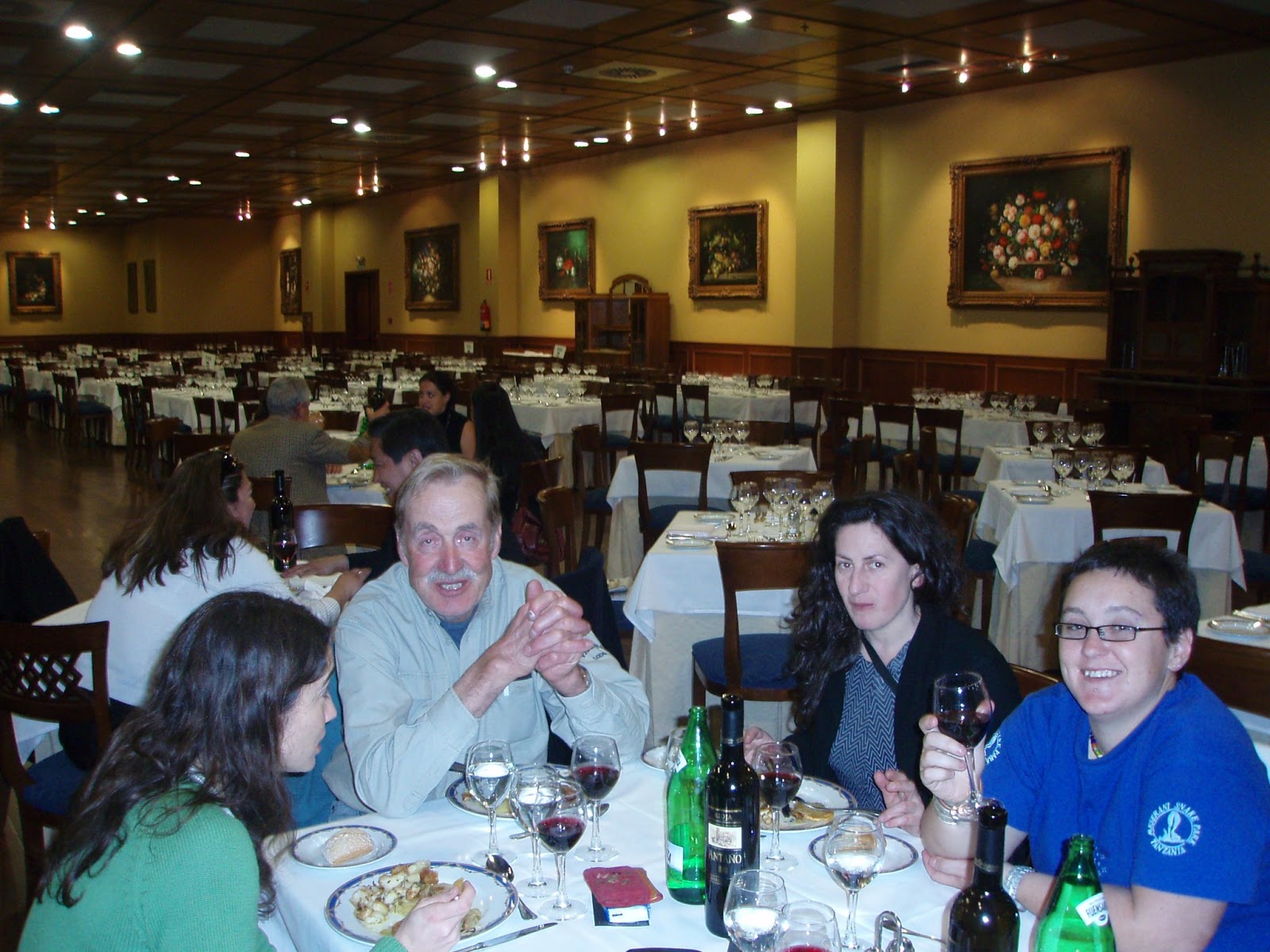
Arrived at last. An exciting journey with delay at Gatwick for Madrid Aerolineas Argentinas, through their agents Air Comet, allowed one hour between flights, stranding its passengers in Madrid for 24 hours. But team spirit prevailed, with Patricia, Lucy, Maria, Lura, Geoffrey and me supporting each other through the luggage-less stop over. It was reminiscent of war-time spirit - but I was not Winston for a change. Letting go, I left it to others to make the speeches.
 Now I am in barrio San Nicholas. What an interesting and animated area. The apartment in Tucuman is great, with a warm and reassuring introduction from Cecilia, my landlady. She is young and glamorous and not at all what a landlady should be like!

ready to depart
18 Mar 2007

It's Sunday. Tomorrow, farewell to Stephanie who will be in residence whilst I am away.

It's Sunday. Tomorrow, farewell to Stephanie who will be in residence whilst I am away.
Tomorrow evening I depart for London. Tuesday will see last minute shopping and a late parting meal in Fitzrovia. Wednesday to Gatwick, on to Madrid and then flight AR1135 to Buenos Aires with a 0630 hrs touchdown.
My few clothes have been laid out in the studio for over a week. I have practised with the Berghaus rucksack/shoulderbag /wheely. My pile of possessions has been like a flower through the seasons: from an immature bud, into full bloom, then shedding as many petals and transforming into a compact fruit. Notably, some of the 'essentials' have given way flights of fancy, with technology creeping tentatively in: the Ipac, webcam and wonderful camera from Stephanie. These leave me feeling that I have a tentative comfort-link back to England and civilisation.
I have just pre-booked my rail ticket. Another milestone because it too is a 'timed' journey. Now the trip seems like childbirth; a journey that must happen and from which there is no turning back. This curiously compounds almost all of the reactions of my friends at work - in chambers and the courts - who have said "You are not coming back, are you?" Am I to be Bilbo Baggins on his farewell journey to Elfland? I feel equally excited and mischievous. I don't know about the fireworks, though!
My next entry will be from my apartment in Tucuman Buenos Aires. Cecilia, my landlady will be there to welcome me to the city and hand me the key. And then the new adventure will start in earnest.
30 days to departure
21 Feb 2007
Today is 21st February and that means I have only one month before departure for BsAs. It still seems unreal after so many years of routine living and working in the UK. And rather scary...and exciting! My plans have gone well up to now and I have even got my Berghaus Jalan (fellow back-packers will understand).

But I am yet to have confirmation of my accommodation, but you can't be that well organised, can you? It is astonishing how many things you have to think of when you go away for such a period of time as six months. Each day something new crops up, reminding me of how we complicate our lives with really unnecessary things. Worth making plans like these just to realise what is important in life - and what is not. 30 days countdown. Next posting just before departure.
first blog entry
02 Feb 2007
This is my first blog entry, so bear with me! As you can see, I am on the departure path for my great adventure...Argentina for 6 months. I have obtained leave of absence from chambers, Stephanie is to house sit and is looking forward to long sunny summer days in England whilst I am enduring a Buenos Aires winter, I have bought my flight tickets, arranged my insurance and thought about packing a bag! And why? Well as those who have visited my YouTube vlog (stephentwist and tango stephen) will realise, to dance Tango.
Clearly, its not just that, as I can dance Tango in here. Its the prospect of breaking out from all that I have done and known, and finding new challenges, perhaps changing my outlook, horizons and myself. Now what do you think? Mad, irresponsible? Or exciting and adventurous? We will see. My next blog entry will be before I depart. See you then!
Subscribe to:
Posts (Atom)